Chinese Tones

Thursday, January 12, 2023

In English, tones are used to indicate whether a sentence is a statement or a question. Changing the tone in English will change the mood or the emphasis of the sentence, but not the meaning of the sentence. Chinese sentences apply the same rules.

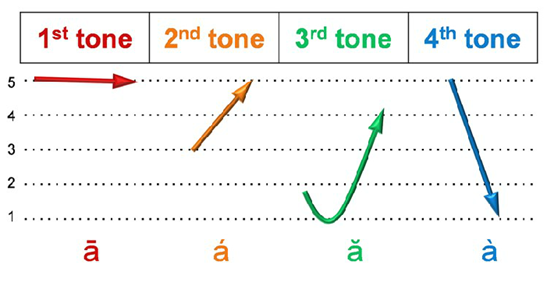
Chinese is a tonal language; each Chinese character has a tone. Each pinyin syllable in Chinese can have 5 possible ways to pronounce by varying the tone (pitch). There are four tones and neutral tone(toneless)in Mandarin Chinese. One syllable. pronounced in different tones will usually mean different things. Comparing with English, which only has rising tone and falling tone, Chinese has four tones including flat tone, rising tone, falling-rising tone and falling tone. As shown in the following table:
Tones, 声调, sheng diao
The 1st tone, flat tone with highest pitch, marked as ā or a1.

The 2nd tone, rising tone, the pitch changes from the middle one to the highest , marked as á or a2.

The 3rd tone, falling-rising tone, the pitch changes from the lower one to the lowest, then from the lowest to the higher, marked as ǎ or a3.

The 4th tone, falling tone, the pitch changes from the highest one to the lowest , marked as àor a4.

For neutral tone also called toneless tone (called “light sound” in Chinese). No marking is put above any vowel, like "a".

In Chinese it is always very important to pronounce characters and words with correct tone. If not, it is difficult to understand each other. For example: the English words “book” and “tree”, the spelling of their pinyin is same but with different tone like” shū” and “shù”, then the words’ meaning are totally different.


Sign up for a free trial now!

FAQ / Tips

We offer a referral program that rewards both you and your friend with free classes.To participate, simply refer a friend to our program and once they successfully enroll, both you and your friend will receive free classes.We appreciate your support and look forward to helping you and your friend achieve your language learning goals.
No, the tuition fees you have paid cover all costs.There are no additional fees or hidden charges. We strive to be transparent and upfront with our pricing, ensuring that our clients receive the best value for their investment.
Our students come from a wide range of ages, from 3 years old to over 80 years old. Our courses are tailored to each student's age and proficiency level to ensure they can receive maximum benefit and progress. Whether you want to learn Chinese as a second language or improve your existing Chinese skills, we can provide you with courses and resources that are suitable for you
We offer secure and convenient payment options, including PayPal. PayPal is a widely recognized and trusted online payment platform that provides a secure way to make transactions. We also follow industry-standard security protocols to ensure the safety of your personal and financial information.
Before starting any Chinese language course, the teacher will assess your Chinese language proficiency level through a placement test.This helps to determine your current level of understanding and ability in Chinese, and allows the teacher to tailor the course materials and teaching methods to your specific needs and goals. The placement test may include assessments of your reading, writing, listening, and speaking skills.Based on the results of the test, the teacher will be able to recommend an appropriate course of study for you.
If you have any questions or concerns, you can send an email to: service @chineselearning.com.We have a team of professionals who will be happy to assist you with any issues as soon as possible.