Chinese idioms are often perceived as cultural and elegant, but some are surprisingly relatable and may not even seem like idioms at all! Take, for example, "makes one spit out food" and "pharmacy flying dragon" - these are indeed authentic idioms with intriguing stories and meanings behind them. Let's delve into the meanings of these "unconventional idioms" to uncover their hidden charm!

令人喷饭 (lìng rén pēn fàn)
- Origin:
From a passage by Su Shi in the Song Dynasty that humorously describes amusing situations, evolving to mean something or someone hilarious that makes people laugh. - Literal Meaning:
Makes one spit out food. - Figurative Meaning:
Describes things or statements that are extremely funny, causing uncontrollable laughter. - Example:
His comedic performance was truly makes one spit out food.
他的滑稽表演实在令人喷饭。
tā de huá jī biǎo yǎn shí zài lìng rén pēn fàn.
药店飞龙 (yào diàn fēi lóng)
- Origin:
Found in Liu Yiqing's "New Accounts of the Tales of the World" in the Southern Song Dynasty, describing a person's slender physique who is compared to a dragon (depicted in pharmacies' herb paintings), symbolizing thinness. - Literal Meaning:
A flying dragon in a pharmacy. - Figurative Meaning:
Metaphor for someone being extremely thin and frail. - Example:
After being ill for a long time, he now looks as thin as a pharmacy flying dragon, evoking sympathy.
他生病许久,如今瘦得像药店飞龙,看着就让人心疼。
tā shēng bìng xǔ jiǔ, rú jīn shòu dé xiàng yào diàn fēi lóng, kàn zhe jiù ràng rén xīn téng.
酒店疯狗 (jiǔ diàn měng gǒu)
- Origin:
From "Inner Enquiries" by Yan Zi Chunqiu, narrating a story where people avoid a hotel due to a fierce dog, cautioning to remove obstructive individuals or objects hindering progress. - Literal Meaning:
A fierce dog in a hotel. - Figurative Meaning:
Describes harmful individuals or obstacles that disrupt progress or success. - Example:
Hiring malicious people in a company is akin to having a hotel fierce dog; talented individuals will leave.
公司若重用小人,无异于酒店猛狗,人才都会离开。
gōng sī ruò zhòng yòng xiǎorén, wú yì yú jiǔ diàn měng gǒu, rén cái dōu huì lí kāi.
冬日可爱 (dōng rì kě ài)
- Origin:
Mentioned in the "Annals of Duke Wen" from the Zuo Tradition, representing warmth and friendliness as compared to the Winter Sun. - Literal Meaning:
The Winter Sun feels lovely. - Figurative Meaning:
Describes a person who is warm and friendly. - Example:
The old principal is as gentle as the Winter Sun, loved by students.
老校长待人如冬日可爱,深受学生敬爱。
lǎo xiào zhǎng dài rén rú dōng rì kě ài, shēn shòu xué shēng jìng ài.
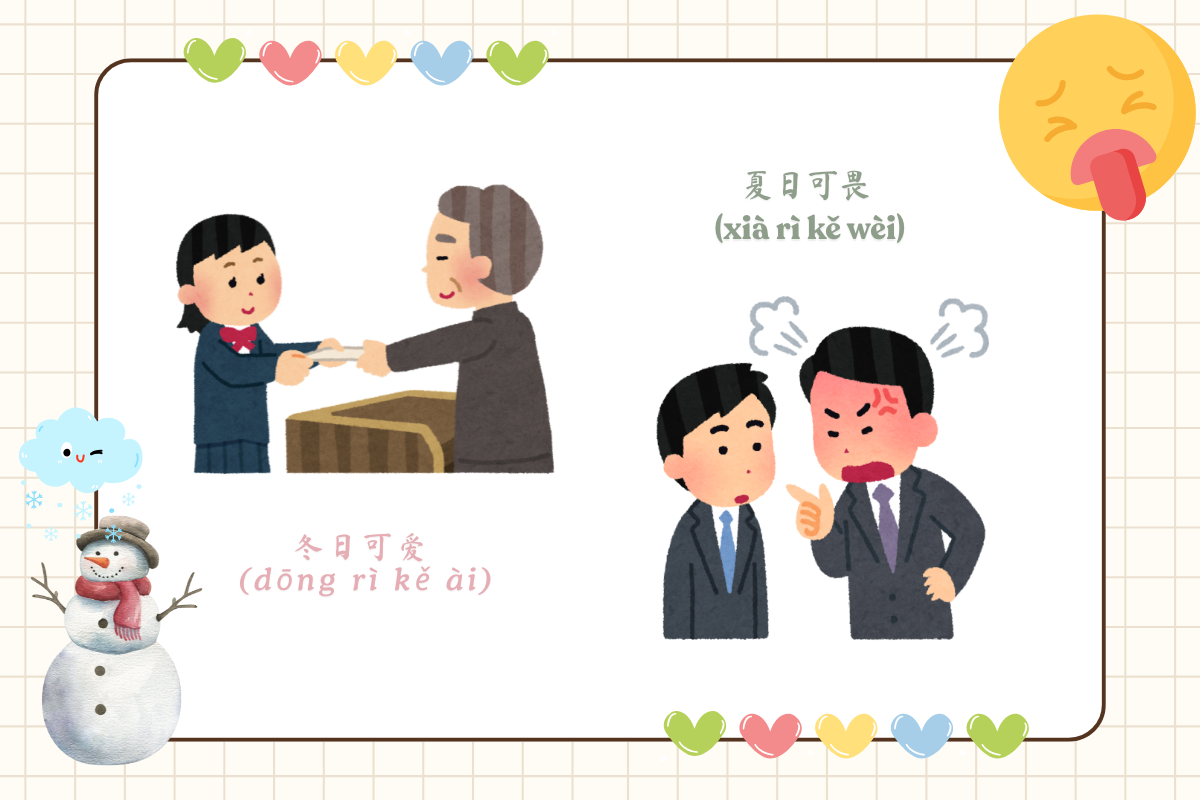
夏日可畏 (xià rì kě wèi)
- Origin:
Similar to "Winter Sun Gentle," it represents the stern and intimidating nature of the Summer Sun. - Literal Meaning:
The scorching Summer Sun is intimidating. - Figurative Meaning:
Describes someone with strict and formidable demeanor, not easily approachable. - Example:
During work, Manager Wang is like the Summer Sun, and employees dare not slack off.
王经理平时工作中夏日可畏,员工们从不敢懈怠。
wáng jīng lǐ píng shí gōng zuò zhōng xià rì kě wèi, yuán gōng men cóng bù gǎn xiè dài.
女生外向 (nǚ shēng wài xiàng)
- Origin:
Derived from Ban Gu's "White Tiger Routine" in the Han Dynasty, depicting a woman's mindset post-marriage that shifts towards the husband's family, symbolizing women growing distant from their own families (now carries neutral or light teasing tones without emphasizing derogatory implications). - Literal Meaning:
A girl's heart leaning towards the outside (referring to the husband's family). - Figurative Meaning:
Refers to women who, after marriage, grow more attached to the husband's family, gradually drifting away from their own (now used with neutral or slightly mocking connotations without emphasizing negativity). - Example:
The traditional belief that women become lady sunward post-marriage is now considered a traditional concept.
古人说女生外向,如今看来是一种传统观念。
gǔ rén shuō nǚ shēng wài xiàng, rú jīn kàn lái shì yī zhǒng chuán tǒng guān niàn.
惨绿少年 (cǎn lǜ shào nián)
- Origin:
Found in Zhang Gu's "Idle Drumming" in the Tang Dynasty, describes a young man's exceptional qualities, known and capable of achieving greatness, being likened to a charming young man dressing modestly in light green. - Literal Meaning:
A young man dressed in light green. - Figurative Meaning:
Originally referred to dashing and promising young men, now signifies talented and charismatic young individuals (where "frightening" connotes "light" rather than "terrifying"). - Example:
He, in a green robe, stands out with exceptional charm, truly exemplifying the classical term "frightening green young."
他一袭青衫,气质出众,堪称惨绿少年。
tā yī xí qīng shān, qì zhì chū zhòng, kān chēng cǎn lǜ shào nián.
一龙一猪 (yī lóng yī zhū)
- Origin:
From Han Yu's "South of the Book City", where children from two families, indistinguishably similar during childhood, diverge in adulthood, one excelling like a dragon, the other remaining average like a pig - highlighting the stark contrast between individuals. - Literal Meaning:
One dragon, one pig. - Figurative Meaning:
Symbolizes a vast difference between two people, one outstanding, the other mediocre. - Example:
Attending the same teacher's lectures, the results show one dragon and one pig, all due to individual effort.
同样名师授课,结果一龙一猪,全在自身努力。
tóng yàng míng shī shòu kè, jié guǒ yī lóng yī zhū, quán zài zì shēn nǔ lì.
破马张飞(pò mǎ zhāng fēi)
- Origin:
Referring to Zhang Fei from the "Romance of the Three Kingdoms", combining with a fatigued and uncontrollable horse - implying reckless behavior akin to the impulsive Zhang Fei, commonly used to describe rash or clumsy conduct (used colloquially with negative connotations). - Literal Meaning:
A horse out of control, resembling Zhang Fei. - Figurative Meaning:
Describes impulsive, rude behavior that lacks restraint (used informally with derogatory implications). - Example:
His behavior during an argument was akin to horse breaking Zhang Fei, frightening everyone.
他吵架时破马张飞的样子,吓坏了所有人。
tā chǎo jià shí pò mǎ zhāng fēi de yàng zi, xià huài le suǒ yǒu rén.
君子豹变 (jūn zǐ bào biàn)
- Origin:
Originating from the "Tire Gua" in the Book of Changes, likening a wise and accomplished individual's growth to that of a leopard evolving from youth to maturity - illustrating a person's gradual refinement and development positively. - Literal Meaning:
A gentleman transforming like a leopard. - Figurative Meaning:
Metaphor for a person's positive growth, gradual improvement in morals and knowledge (as leopards have their distinctive markings developed in adulthood, signifying constant growth). - Example:
After a decade of studying hard, his transformation like a gentleman leopard has made him a leading figure in academia.
他十年苦读,君子豹变,如今已成学界翘楚。
tā shí nián kǔ dú, jūn zǐ bào biàn, rú jīn yǐ chéng xué jiè qiào chǔ.
夫人虎变 (fū rén hǔ biàn)
- Origin:
Also from the "Tire Gua" in the Book of Changes, emphasizing the transformation attributed to the dignified stance that comes with social status changes such as observed in noble ladies, meant to highlight the respectful demeanor related to one's status. - Literal Meaning:
A lady transforming like a tiger. - Figurative Meaning:
Originally symbolized the noble appearance of a king's wife due to her position, later emphasizing the dignified and solemn aura accompanying societal status changes (with the tiger's transformation metaphor representing transformative social gesture changes, now less commonly used). - Example:
Her words and actions gradually become dignified and respectable, fully embracing the lady tiger transformation's grace.
她言行举止逐渐端庄威严,尽显夫人虎变的仪态。
tā yán xíng jǔ zhǐ zhú jiàn duān zhuāng wēi yán, jìn xiǎn fū rén hǔ biàn de yí tài.
Indeed, these seemingly peculiar idioms are the brilliant products of ancient wisdom. They express profound truths in a simple and vivid manner. So, the next time you hear "Winter Sun Gentle" or "Hotel Fierce Dog," remember that these phrases are not just casual expressions but carry the weight of centuries-old idioms! Isn't that fascinating?