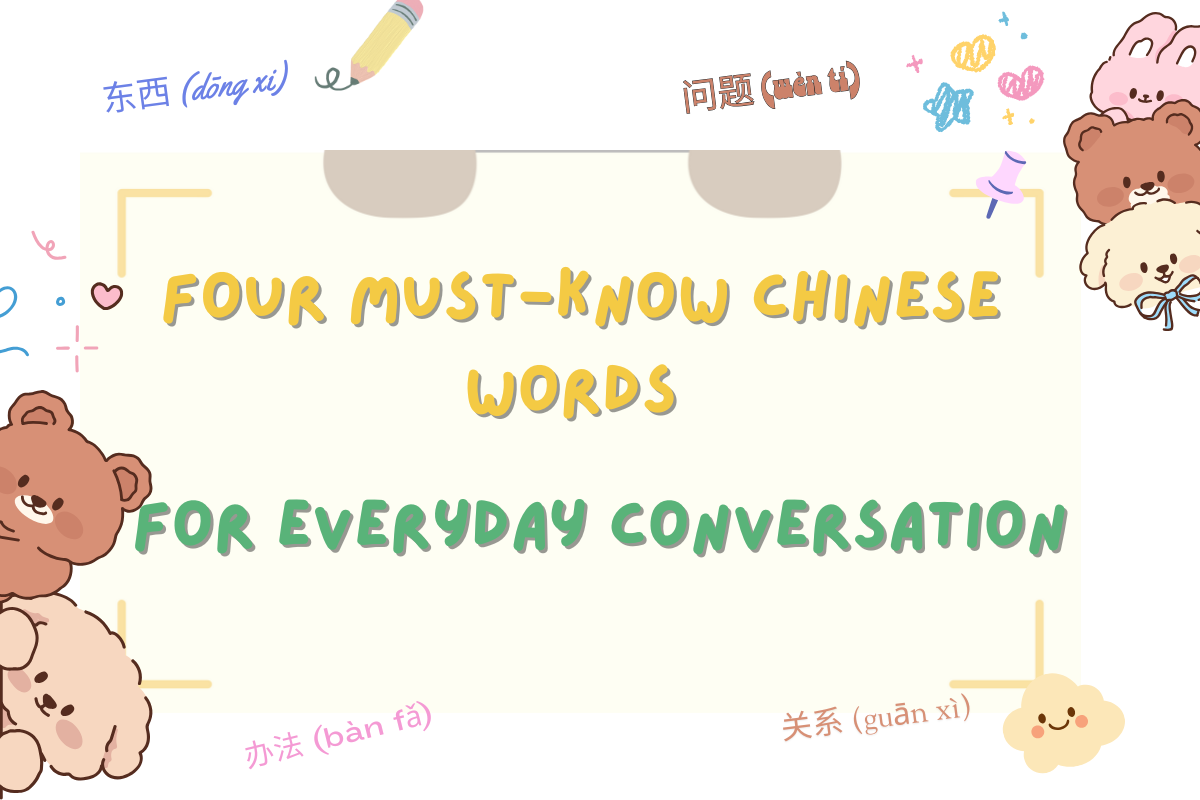
In daily Chinese conversations, the words “东西 (dōngxi)”, “问题 (wèntí)”, “办法 (bànfǎ)”, and “关系 (guānxì)” are used all the time. These are very flexible words that can mean many things depending on the situation. They can talk about real objects or more abstract ideas, and they are key to making your Chinese sound natural and fluent. Let’s get to know them!
东西 (dōng xi) — “Thing” (Can Mean Object, Idea, or Even a Person)
Talking about real objects:
- “帮我递一下桌上的那个东西(如杯子)。”
bāng wǒ dì yī xià zhuō shàng de nà ge dōng xi (rú bēi zi).
Please pass me that thing (like the cup) on the table. - “买东西(购物)时别忘带袋子。”
mǎi dōng xi (gòu wù) shí bié wàng dài dài zi.
Don’t forget to bring a bag when you go shopping.
Talking about abstract things:
- “他说话总藏着东西(隐情)。”
tā shuō huà zǒng cáng zhe dōng xi (yǐn qíng).
He always hides something (some secret) when he talks. - “这个新软件里有不少好东西(有用功能)。”
zhè ge xīn ruǎn jiàn lǐ yǒu bù shǎo hǎo dōng xi (yǒu yòng gōng néng).
This new software has a lot of good things (useful features).
Talking about people (with a feeling, sometimes cute, sometimes negative):
- “你这小东西(亲昵,对小孩)真调皮。”
nǐ zhè xiǎo dōng xi (qīn nì, duì xiǎo hái) zhēn tiáo pí.
You little rascal (said affectionately to a child), you’re so naughty! - “他不是个靠谱东西(贬义,指人)。”
tā bù shì gè kào pǔ dōng xi (biǎn yì, zhǐ rén).
He’s not a reliable guy (negative meaning).
问题 (wèn tí) — “Problem” or “Question”
A problem or difficulty that needs fixing:
- “电脑出了点问题(故障),得修一下。”
diàn nǎo chū le diǎn wèn tí (gù zhàng), děi xiū yī xià.
The computer has a problem (is broken), it needs to be fixed. - “工作中遇到问题(难题)别慌,慢慢想。”
gōng zuò zhōng yù dào wèn tí (nán tí) bié huāng, màn màn xiǎng.
Don’t panic when you have problems at work, just think it through.
A question or something to confirm:
- “我有个问题(疑问)想问你。”
wǒ yǒu gè wèn tí (yí wèn) xiǎng wèn nǐ.
I have a question to ask you. - “关于会议时间,还有一个小问题(待确认的点)。”
guān yú huì yì shí jiān, hái yǒu yī gè xiǎo wèn tí (dài què rèn de diǎn).
There’s still a small question about the meeting time (something to confirm).
Common phrases:
- “没问题(méi wèn tí)” (No problem / Sure!):
“这事交给我,没问题!”
zhè shì jiāo gěi wǒ, méi wèn tí!
Leave this to me, no problem!
- “出问题(chū wèn tí)” (Something goes wrong):
“这台机器用久了容易出问题。”
zhè tái jī qì yòng jiǔ le róng yì chū wèn tí.
This machine often has problems after a long time.
- “解决问题(jiě jué wèn tí)” (Solve a problem):
“我们得尽快解决这个问题。”
wǒ men děi jìn kuài jiě jué zhè ge wèn tí.
We need to solve this problem as soon as possible.
办法 (bàn fǎ) — “Way” or “Method” (to solve a problem)
Emphasizes how to fix something:
- “堵车了,有没有别的办法(路线)能快点到?”
dǔ chē le, yǒu méi yǒu bié de bàn fǎ (lù xiàn) néng kuài diǎn dào?
There’s a traffic jam, is there another way (route) to get there faster? - “他总能想出好办法(方案)解决难题。”
tā zǒng néng xiǎng chū hǎo bàn fǎ (fāng àn) jiě jué nán tí.
He can always come up with a good way (solution) to solve problems.
Other use:
- “没办法,只能等明天了。”
méi bàn fǎ, zhǐ néng děng míng tiān le.
There’s no way, we’ll have to wait until tomorrow. - “有办法让文件快点传过来吗?”
yǒu bàn fǎ ràng wén jiàn kuài diǎn chuán guò lái ma?
Is there a way to send the file faster?
Common phrases:
- “想办法(xiǎng bàn fǎ)” (Think of a way):
“大家一起想办法应对危机。”
dà jiā yī qǐ xiǎng bàn fǎ yìng duì wēi jī.
Let’s all think of a way to deal with the crisis.
- “找办法(zhǎo bàn fǎ)” (Look for a way):
“我得找办法修补这个漏洞。”
wǒ děi zhǎo bàn fǎ xiū bǔ zhè ge lòu dòng.
I need to find a way to fix this problem.
- “没办法(méi bàn fǎ)” (No way):
“时间太紧,没办法完成所有任务了。”
shí jiān tài jǐn, méi bàn fǎ wán chéng suǒ yǒu rèn wu le.
There’s not enough time, there’s no way to finish all the tasks.
关系 (guān xì) — “Relationship” or “Connection”
Talking about relationships between people:
- “我和他是大学同学,关系不错。”
wǒ hé tā shì dà xué tóng xué, guān xì bù cuò.
He and I are college classmates, we have a good relationship. - “家人之间要维护好关系(感情)。”
jiā rén zhī jiān yào wéi hù hǎo guān xì (gǎn qíng).
Family members should maintain a good relationship (emotion).
Talking about connections between things:
- “天气和农作物产量有直接关系。”
tiān qì hé nóng zuò wù chǎn liàng yǒu zhí jiē guān xì.
The weather is directly related to crop yield. - “这个参数和设备性能的关系很密切。”
zhè ge cān shù hé shè bèi xìng néng de guān xì hěn mì qiè.
This parameter is closely related to the device’s performance.
Common phrases:
- “有关系(yǒu guān xì)” (It matters / is related):
“这事儿和我有关系。”
zhè shì er hé wǒ yǒu guān xì.
This matter is related to me.
- “没关系(méi guān xì)” (It doesn’t matter / Don’t worry):
“没关系,这不是什么大事。”
méi guān xì, zhè bú shì shén me dà shì.
It’s okay, it’s not a big deal.
- “搞关系(gǎo guān xì)” (Networking / building connections):
“职场中靠搞关系不如靠实力。”
zhí chǎng zhōng kào gǎo guān xì bù rú kào shí lì.
In the workplace, relying on connections isn’t as good as relying on your own ability.
Now you know these four common and useful abstract words in Chinese! Try making your own sentences with them, or use them in your daily life to sound more natural in Chinese!