
When learning Chinese, many beginners notice something strange: you know every word in a sentence, but when you put them together, it still doesn’t sound natural—at least, not like a native speaker. Why? One big reason is the use of fixed verb-object phrases in Chinese. These are set word combinations, just like English “phrasal verbs” (for example, “take a shower” or “do homework”). They are the building blocks of everyday Chinese.Below are some of the most common verb-object phrases, organized by theme.

Daily Life
刷牙 (shuā yá): brush teeth
- Example:
每天早晚都要刷牙。
měi tiān zǎo wǎn dōu yào shuā yá.
You should brush your teeth every morning and night.
洗脸 (xǐ liǎn): wash face
- Example:
早上用冷水洗脸很舒服。
zǎo shang yòng lěng shuǐ xǐ liǎn hěn shū fu.
It feels good to wash your face with cold water in the morning.
洗澡 (xǐ zǎo): take a shower
- Example:
运动后我想洗澡。
yùn dòng hòu wǒ xiǎng xǐ zǎo.
After exercising, I want to take a shower.
刮胡子 (guā hú zi): shave beard
- Example:
爸爸每天刮胡子。
bà ba měi tiān guā hú zi.
Dad shaves his beard every day.
School & Work
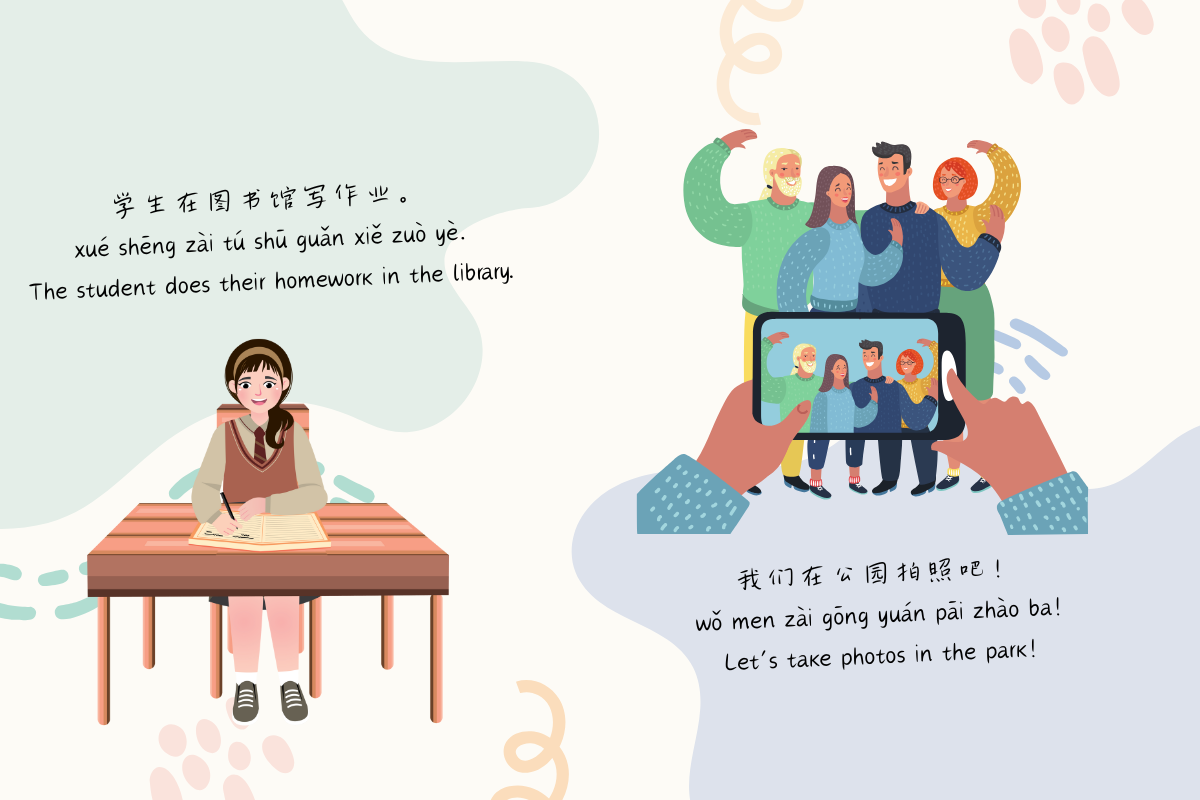
写作业 (xiě zuò yè): do homework
- Example:
学生们在图书馆写作业。
xué shēng men zài tú shū guǎn xiě zuò yè.
The students do their homework in the library.
上课 (shàng kè): attend class
- Example:
我们上午八点上课。
wǒ men shàng wǔ bā diǎn shàng kè.
We have class at 8 a.m.
上班 (shàng bān): go to work
- Example:
妈妈坐地铁去上班。
mā ma zuò dì tiě qù shàng bān.
Mom takes the subway to go to work.
开会 (kāi huì): have a meeting
- Example:
今天下午经理要开会。
jīn tiān xià wǔ jīng lǐ yào kāi huì.
The manager will have a meeting this afternoon.
Leisure & Entertainment
看电视 (kàn diàn shì): watch TV
- Example:
爷爷喜欢看电视新闻。
yé ye xǐ huan kàn diàn shì xīn wén.
Grandpa likes watching TV news.
拍照 (pāi zhào): take photos
- Example:
我们在公园拍照吧!
wǒ men zài gōng yuán pāi zhào ba!
Let’s take photos in the park!
踢足球 (tī zú qiú): play football (soccer)
- Example:
男生们放学后踢足球。
nán shēng men fàng xué hòu tī zú qiú.
The boys play football after school.
打篮球 (dǎ lán qiú): play basketball
- Example:
我每周打篮球三次。
wǒ měi zhōu dǎ lán qiú sān cì.
I play basketball three times a week.
Going Out
坐公交 (zuò gōng jiāo): take the bus
- Example:
我经常坐公交去学校。
wǒ jīng cháng zuò gōng jiāo qù xué xiào.
I often take the bus to school.
打车 (dǎ chē): take a taxi
- Example:
下雨时我们打车回家。
xià yǔ shí wǒmen dǎ chē huí jiā.
When it rains, we take a taxi home.
买东西 (mǎi dōng xi): go shopping/buy things
- Example:
周末超市里很多人买东西。
zhōu mò chāo shì lǐ hěn duō rén mǎi dōng xi.
A lot of people go shopping in the supermarket on weekends.
逛公园 (guàng gōng yuán): stroll in the park
- Example:
老人们喜欢早上逛公园。
lǎo rén men xǐ huan zǎo shang guàng gōng yuán.
Elderly people like to stroll in the park in the morning.
Special Usage Tips
Adding measure words: If you want to talk about a specific number, add a measure word in the middle.
Example:
- 拍一张照片
pāi yì zhāng zhào piàn
take one photo - 开一个会
kāi yí gè huì
have one meeting
Object at the front: Sometimes, especially in negative sentences, the object comes before the verb.
Example:
- 作业写完了
zuò yè xiě wán le
Homework is done.
Verb reduplication: Some verbs can be repeated to sound more casual or relaxed.
Example:
- 散散步
sàn sàn bù
take a little walk - 听听歌
tīng tīng gē
listen to some music
Have you learned all these verb-object pairs? Try making your own combinations and see how natural your Chinese sounds!