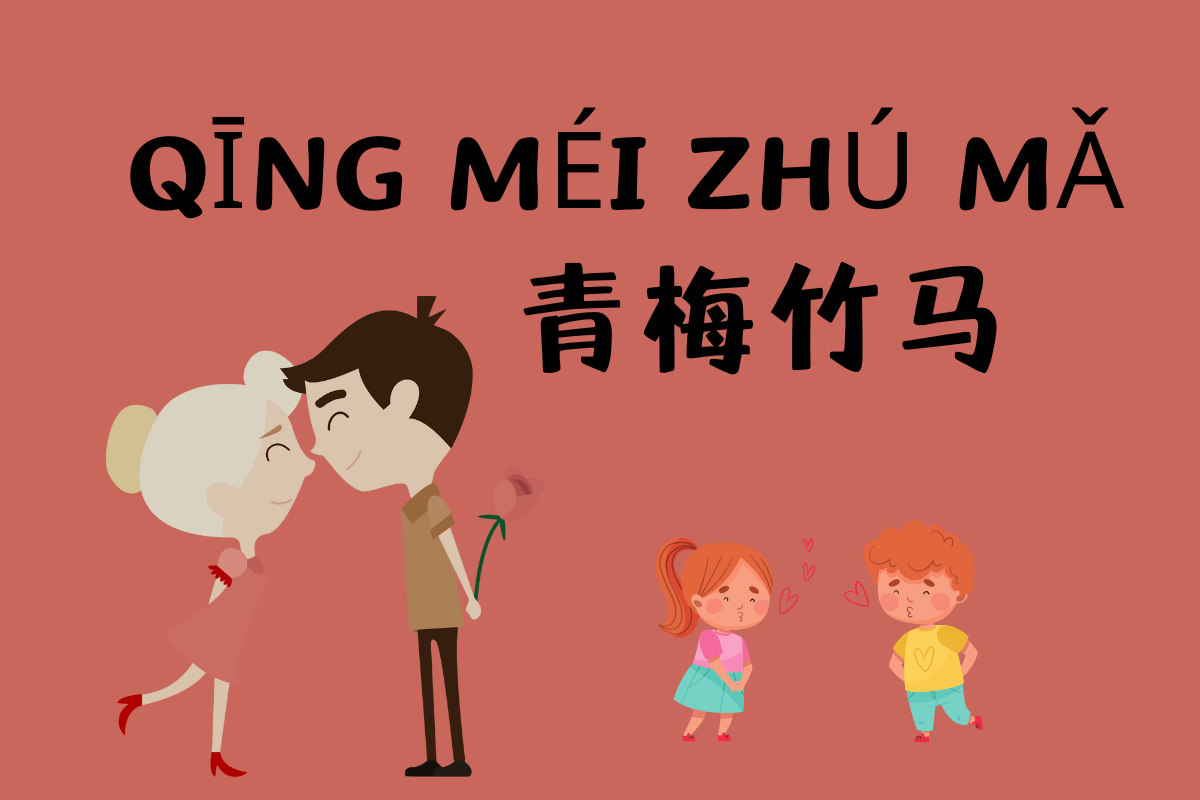
青梅竹马 (qīng méi zhú mǎ) is a well-known Chinese idiom. It is often translated as “childhood sweethearts,” but its meaning can also be broader. It describes two people who grew up together and have known each other since childhood.
This Chinese idiom comes from a famous poem by the Tang dynasty poet Li Bai, not from a folk story about two children named Mei and Zhu.
What Does 青梅竹马 Mean?
青梅 (qīng méi) literally means “green plums.”
竹马 (zhú mǎ) literally means “bamboo horse,” a simple toy children used to play with in ancient China.
Together, 青梅竹马 describes a close relationship formed in childhood. In modern Chinese, it is often used for childhood sweethearts, but it can also refer to childhood friends who grew up together.
The Origin of 青梅竹马
The idiom comes from Li Bai’s poem 长干行 (Cháng Gān Xíng), often translated as The River Merchant’s Wife or Chang Gan Xing.
The famous lines are:
郎骑竹马来,绕床弄青梅。
同居长干里,两小无嫌猜。
A simple meaning is:
The boy came riding on a bamboo horse, and the girl played with green plums. They lived in the same neighborhood in Changgan and grew up together without suspicion or distance.
These lines describe innocent childhood play. Later, 青梅竹马 became a common idiom for people who have known each other since they were young.
How Is 青梅竹马 Used Today?
Today, 青梅竹马 is often used to describe a couple who grew up together and later fell in love. It carries a warm, nostalgic feeling.
For example, if two people were neighbors as children, went to school together, and later became a couple, Chinese speakers might say they are 青梅竹马.
It can also describe a very close childhood bond, even if the relationship is not romantic. However, in daily use, the romantic meaning is especially common.
Example Sentences
1. They were childhood sweethearts.
他们是青梅竹马。
Tāmen shì qīng méi zhú mǎ.
2. They grew up together and later got married.
他们从小一起长大,后来结婚了,真是青梅竹马。
Tāmen cóng xiǎo yìqǐ zhǎng dà, hòulái jiéhūn le, zhēn shì qīng méi zhú mǎ.
3. My parents were childhood sweethearts.
我的父母是青梅竹马。
Wǒ de fùmǔ shì qīng méi zhú mǎ.
4. They have known each other since childhood.
他们从小就认识,可以说是青梅竹马。
Tāmen cóng xiǎo jiù rènshi, kěyǐ shuō shì qīng méi zhú mǎ.
Useful Vocabulary
童年 (tóng nián): childhood
Example:
我的童年很快乐。
Wǒ de tóngnián hěn kuàilè.
My childhood was very happy.
友谊 (yǒu yì): friendship
Example:
他们之间有很深的友谊。
Tāmen zhījiān yǒu hěn shēn de yǒuyì.
They have a deep friendship.
长大 (zhǎng dà): to grow up
Example:
他们一起长大。
Tāmen yìqǐ zhǎng dà.
They grew up together.
Qing Mei Zhu Ma and Liang Xiao Wu Cai
Another related expression is 两小无猜 (liǎng xiǎo wú cāi). It also comes from Li Bai’s poem.
两小无猜 describes two children who are innocent, close, and free from suspicion. 青梅竹马 focuses more on the image of childhood play and the relationship that grows from it.
The two idioms are often used together:
青梅竹马,两小无猜。
This means two people grew up together in an innocent and close relationship.
Final Thoughts
青梅竹马 is a beautiful Chinese idiom because it carries both a literal image and a cultural memory. The green plums and bamboo horse come from Li Bai’s poem, and together they represent childhood closeness, innocence, and long-lasting affection.
If you are learning Chinese, idioms like 青梅竹马 are a good way to understand not only vocabulary, but also Chinese poetry, culture, and everyday expression.