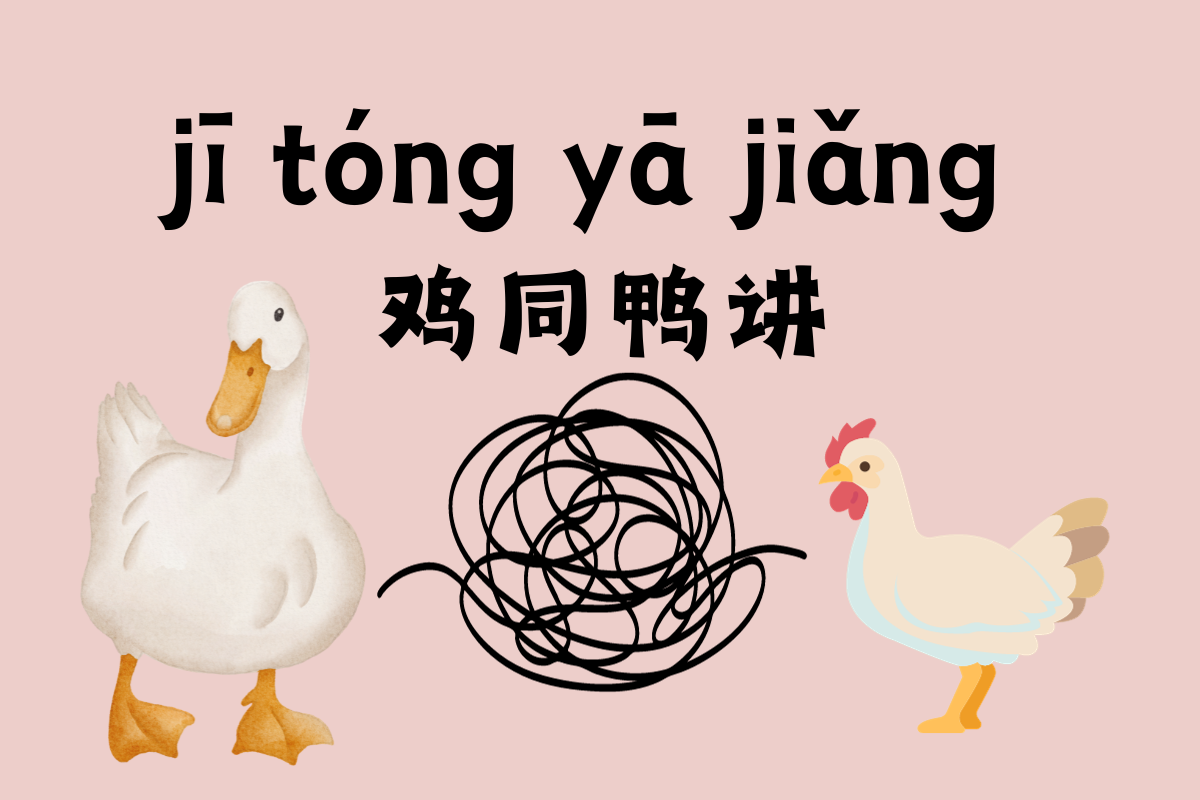
"鸡同鸭讲" (jī tóng yā jiǎng) is a Chinese idiom used to describe situations where two parties find it challenging to understand or communicate with each other due to language barriers. This article delves into the meaning, inspiration, and modern applications of this idiom through an engaging story.
The Story
Long ago, in a small village, there lived a chicken and a duck. They both resided on the same farm but had entirely different ways of vocalizing. The chicken's sound was “gegege,” while the duck's sound was “gagaga.” They wished to 沟通(gōutōng)communicate with each other, but due to their distinct languages, they couldn't comprehend one another's meanings. They became deeply confused and lonely as they struggled to bridge the language gap.
沟通(gōutōng),verb,communicate
We need to communicate better with our team.
我们需要更好地沟通与我们的团队。
Wǒmen xūyào gèng hǎo de gōutōng yǔ wǒmen de tuánduì.
Clear communication is essential for a successful project.
清晰的沟通对于一个成功的项目是至关重要的。
Qīngxī de gōutōng duìyú yīgè chénggōng de xiàngmù shì zhìguān zhòngyào de.
Inspiration
"鸡同鸭讲" reminds us of the importance of language and the challenges that arise when language cannot bridge the gap between individuals. This idiom teaches us to listen, understand, and respect different voices and perspectives. In today's 多元文化的(duōyuán wénhuà de)multicultural society, understanding and accommodating various languages and cultures are crucial.
多元文化的(duōyuán wénhuà de),adj,multicultural
Our school is multicultural, with students from various countries.
我们学校是多元文化的,有来自不同国家的学生。
Wǒmen xuéxiào shì duōyuán wénhuà de, yǒu láizì bùtóng guójiā de xuésheng.
Multicultural societies celebrate diversity and promote understanding.
多元文化社会庆祝多样性并促进理解。
Duōyuán wénhuà shèhuì qìngzhù duōyàng xìng bìng cùjìn lǐjiě.
Meaning of the Idiom
"鸡同鸭讲" refers to the difficulty of mutual understanding or communication due to language barriers.
Modern Application
The wisdom of "鸡同鸭讲" remains valuable in contemporary society. It urges us to address communication challenges across languages and cultures, promoting respect and understanding of diverse perspectives. In international cooperation, business interactions, and social exchanges, this idiom underscores the importance of effective communication.
They tried to communicate, but due to speaking different languages, it was like "talking to a brick wall"
他们试图沟通,但由于说不同的语言,就像"鸡同鸭讲"一样。
Tāmen shìtú gōutōng, dàn yóuyú shuō bùtóng de yǔyán, jiù xiàng "jī tóng yā jiǎng" yīyàng.
Participants often feel like "talking to a brick wall."
参与者常常感到"鸡同鸭讲"。
Cānyùzhě chángcháng gǎndào "jī tóng yā jiǎng".
Differences in language often lead to "talking to a brick wall" scenarios.
语言不同经常发生鸡同鸭讲的情况。
Yǔyán bùtóng jīngcháng fāshēng jī tóng yā jiǎng de qíngkuàng.