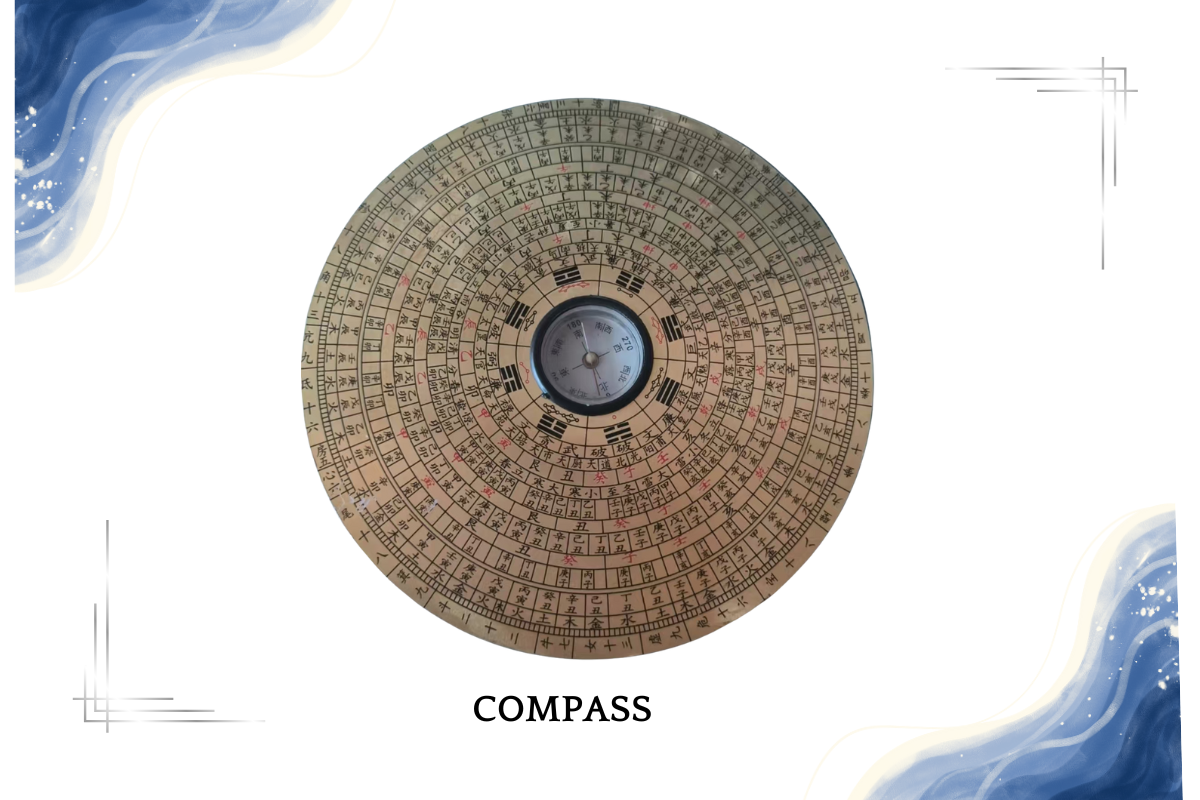
Within the traditional Chinese Feng Shui system, the compass罗盘(luó pán) holds a pivotal role, serving not only as an indispensable tool for Feng Shui practitioners but also embodying profound cultural and philosophical meanings. It carries the ancient understanding of the relationships between the universe, nature, and human living environments.
罗盘(luó pán),noun,compass
Example:
- Use a compass to find direction.
用罗盘辨别方向。
yòng luó pán biàn bié fāng xiàng. - The explorer carried a brass compass.
探险家带着黄铜罗盘。
tàn xiǎn jiā dài zhe huáng tóng luó pán.
Origin and Development of the Compass
The precursor of the compass was the sinan, first documented in the Warring States period in the book "Han Feizi - Youdupian." During that time, the sinan resembled a ladle with a hemisphere base inscribed with "Ganzhi" markings, used to discern directions using the magnetic properties of the needle. As time progressed, by the Song Dynasty, Shen Kuo recorded the use of floating water and magnetic needles with angle deviations in his work "Mengxi Bitan," significantly enhancing the compass's accuracy and practicality. In the Southern Song period, an independent instrument compass was formally crafted and widely used in navigation.
The application of the compass in Feng Shui gradually evolved. During the Tang Dynasty, the Feng Shui master Yang Junsong redesigned the compass, merging the two positioning systems of Bagua and the Twelve Earthly Branches, integrating the Heavenly Stems to indicate directions. The ground plane was divided into twenty-four equal parts, known as twenty-four mountains, becoming an essential foundation for later compasses. The "Yang Pan," comprising the ground plate, sky plate, and seventy-two dragon plate designed by Yang, further improved the basic structure of the compass. Later, in the Song Dynasty, Lai Buyi added the human plate, dedicated to resolving negative energies, refining the primary framework and levels of the compass.
Structure of the Compass
The compass mainly consists of three parts: the sky plate, inner plate, and outer plate:
- Sky Plate: Also known as the sea bottom, housing the compass needle, composed of the top needle, magnetic needle, sea bottom line, cylindrical outer casing, and a glass cover. The magnetic needle, situated above the top needle at the bottom, can freely rotate. Modern compasses often feature cross lines on the sea bottom, aligning the magnetic needle's north end with the north end of the cross lines to determine the north-south direction.
- Inner Plate: A rotating disc adjacent to the sky plate with concentric circles, each representing a layer divided into different sections, inscribed with various symbols including Bagua, Heavenly Stems and Earthly Branches, twenty-four mountains, Nine Stars, and sixty-four hexagrams, carrying rich Feng Shui information. Compasses vary in layers from a minimum of five to a maximum of fifty-two layers.
- Outer Plate: Square in shape, acting as the support tray for the inner plate. Small holes at the midpoint of each side insert a red thread forming the Heavenly Center Ten Lines, used to read the content on the inner plate. The Heavenly Center Ten Lines must be perpendicular, requiring the calibration of the outer plate before using a new compass.
Types of Compasses
Due to the diverse Feng Shui schools, the compass is categorized into various types:
- San Yuan Compass: Also known as the "Jiang Pan," displaying the pre-heaven Bagua, post-heaven Bagua, totaling sixty-four hexagrams, primarily used by the Form School.
- San He Compass: Referred to as the "Yang Gong Pan," featuring three layers of twenty-four mountain orientations, commonly used by the Compass School.
- San Yuan San He Comprehensive Compass: Integrating the characteristics of the San Yuan and San He compasses. Modern Feng Shui often combines Form and Compass Schools, making this comprehensive compass widely applied.
Additionally, there are Yi Pan, Xuan Kong Pan, and various school-specific compasses, but regardless of the type, all compasses include a layer with twenty-four mountain directions, starting from the north, each representing different positions.
Application of the Compass in Feng Shui
In Feng Shui practice, the compass has widespread uses:
- Determination of Directions and Sitting Positions: Standing at the center of a house or another focal point, the compass measures the directions of key locations such as the front door and head of the bed, establishing the sitting orientation of the house, such as facing north or east, thereby analyzing the distribution of energies.
- Feng Shui Layout布局(bù jú): Measuring the orientations of different rooms, combined with the occupant's Bazi destiny analysis, identifying auspicious and inauspicious positions. Essential areas like bedrooms and study rooms are organized in auspicious positions, while areas like kitchens and bathrooms are avoided in inauspicious sections.
布局(bù jú),noun,layout
Example:
- The room has a spacious layout.
房间布局很宽敞。
fáng jiān bù jú hěn kuān chang. - Design the webpage layout first.
先设计网页布局。
xiān shè jì wǎng yè bù jú.
- Selection of Auspicious Dates and Time: Combining compass measurements with the information from the Chinese calendar, selecting favorable dates and times for activities such as groundbreaking, moving, or weddings.
- Alleviating Negative Energies: Using the compass to identify sources of negative energies, such as sharp corners or utility poles, and then taking corresponding measures to counteract them, like placing screens or hanging Bagua mirrors.
Guidelines for Using the Compass
When using the compass, it is essential to consider the following points:
- Avoid Interference: Stay away from metal objects, electronic devices, and environments with strong magnetic fields to prevent inaccuracies in the needle readings, ensuring precise measurements without deviations.
- Practical Integration: Compass measurements should be assessed in conjunction with the house structure, surroundings, and individual Bazi analysis, avoiding blindly following theoretical concepts.
- Respect Tradition: As an essential tool in Feng Shui practices, using the compass should be done with reverence, adhering to traditional etiquette.
The compass, being a crucial tool in Chinese Feng Shui, has undergone centuries of development and evolution, amalgamating knowledge from astronomy, geography, mathematics, philosophy, aesthetics, and more. It not only represents the wisdom of ancient times but also serves as a unique medium connecting humans with nature, exploring the mysteries of the universe. In the modern era, it continues to captivate numerous scholars and enthusiasts, emanating the enduring and enigmatic allure of ancient traditions.