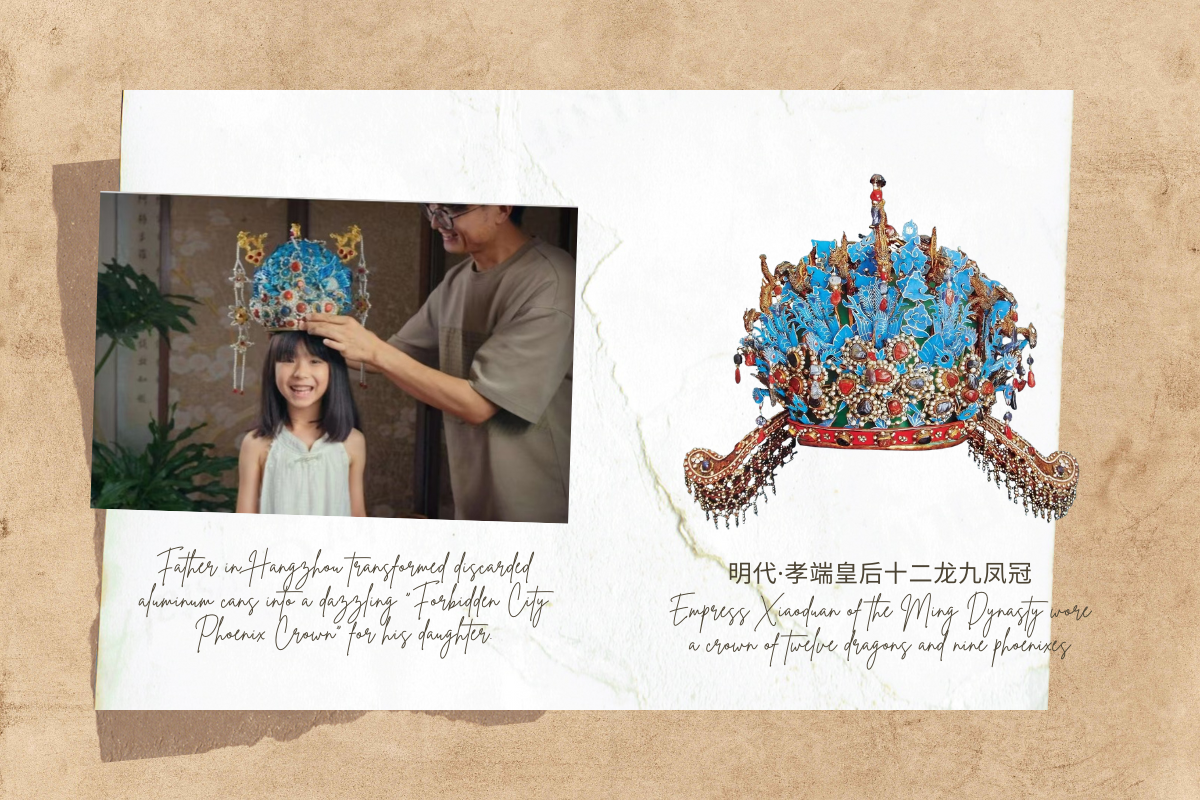
When a father in Hangzhou spends hundreds of hours transforming discarded aluminum cans into a dazzling "Forbidden City Phoenix Crown" for his daughter, he not only creates a gift but also inadvertently builds a bridge connecting modern life with traditional craftsmanship. Behind this aluminum can phoenix crown lies the precious artistry of royal gold and silver filigree craftsmanship that has been passed down for centuries—a craft listed as a national intangible cultural heritage.
Historical Evolution of the Phoenix Crown
The phoenix crown is a ceremonial headdress worn by ancient Chinese imperial consorts and noblewomen at important events, with its history dating back to the Han Dynasty. It became formalized during the Tang and Song Dynasties, reaching its peak in craftsmanship during the Ming and Qing Dynasties. The phoenix crown excavated from the Dingling Tomb in the Ming Dynasty, worn by Empress Dowager Xiaoduan, features a three-dimensional design of nine dragons and nine phoenixes woven from gold thread, inlaid with over a hundred red and blue gemstones and more than 5,000 pearls, weighing a staggering 2,000 grams in pearls alone. This masterpiece, combining skills like goldwork, inlay work, and jewelry mounting, represents the pinnacle of ancient Chinese gold and silver filigree craftsmanship. Following the decline of the feudal system in the Qing Dynasty, the phoenix crown faded, but its craftsmanship continued 延续(yán xù) through mediums like opera costumes and folk weddings.
延续(yán xù), verb, continued
Example:
- The tradition continued for centuries.
这个传统延续了几百年。
zhè ge chuán tǒng yán xù le jǐ bǎi nián. - The meeting continued until midnight.
会议延续到深夜。
huì yì yán xù dào shēn yè.
Material Evolution in Phoenix Crown Manufacturing
Traditional phoenix crowns were centered around precious materials:
Metal Framework: Gilded gold, silver, or copper frames representing nobility;
Main Decorations: Pearls (symbolizing purity), gemstones (such as red and blue gems, jade), kingfisher feathers (now replaced with dyed goose feathers);
Auxiliary Materials: Silk, tassels, cloisonné, among others.
In contemporary intangible cultural heritage innovations, recycled materials like aluminum cans, copper wire, resin are widely used. As seen in the aluminum can phoenix crown created by the Hangzhou father, the matte finish of the metal simulates the effect of kingfisher feathers, making it environmentally friendly and reducing the barrier to experiencing intangible cultural heritage, embodying the Eastern wisdom of "out with the old, in with the new."
Craft Analysis: Millennia-old Skills at Your Fingertips
Filigree Inlaying (National Intangible Cultural Heritage): Drawing metal into fine wires, crafting three-dimensional dragon and phoenix motifs through cutting, filling, and soldering steps, with the margin of error controlled to the millimeter;
Kingfisher Feather Simulating: Attaching feathers to a metal base to create iridescent hues (modern alternatives include fired glaze or dyed materials);
Engraving: Hand-carving three-dimensional patterns onto metal, imparting a sense of fluidity to the metal;
Bead Stringing: Arranging pearls and gemstones in strict hierarchy to balance visual aesthetics and weight.
A traditional phoenix crown requires dozens of craftsmen collaborating for several months, whereas modern simplified techniques (like cutting aluminum cans, wire fabrication) focus more on the inheritance of core techniques and artistic expression.
Cultural Significance Encompassed by the Phoenix Crown
Symbol of Status: In ancient times, the phoenix crown was an exclusive headdress for imperial consorts and noblewomen, with strict regulations on decoration and style, serving as a significant symbol of status and hierarchy.
Auspicious 吉祥(jí xiáng) Symbolism: The phoenix, a symbol of auspiciousness and nobility, the phoenix motif on the crown signifies good fortune, happiness, and an aspiration for a better life.
吉祥(jí xiáng), adjective, auspicious
Example:
- People exchange auspicious greetings during New Year.
新年时人们互道吉祥话。
xīn nián shí rén men hù dào jí xiáng huà. - The dragon is an auspicious creature.
龙是吉祥的动物。
lóng shì jí xiáng de dòng wù.
Aesthetic Artistic Expression: The phoenix crown combines numerous intricate crafts, its exquisite design, magnificent colors, and ingenious layout reflect the aesthetic ideals and advanced artistic skills of the time, serving as an essential carrier of traditional Chinese aesthetic culture.
From the treasures of the Forbidden City to the transformation of recycled aluminum cans, the evolution of phoenix crown craftsmanship mirrors a condensed history of Chinese culture. It signifies not only the preservation of skills but also the materialization of national aesthetics and values. When a modern father handcrafts a phoenix crown for his daughter, he not only conveys a dazzling appearance but also passes on the flames of "craftsmanship" and "cultural identity."