Beijing Opera facial makeup is a unique cosmetic art form within traditional Chinese opera, using vivid colors and patterns to portray characters' personalities, identities, and fates. It serves as a crucial element in Beijing Opera performances and stands as a significant symbol of Chinese cultural heritage.
Origin and Development
Historical Roots:
The art of facial makeup traces back to Tang Dynasty's song and dance masks 面具(miàn jù), integrating gradually with theatrical performances during the Song and Yuan Dynasties, becoming systematized with the rise of Beijing Opera during the Ming and Qing Dynasties, serving as a visual language for character classification.
面具(miàn jù), noun, masks
Example:
- The actors wore colorful masks.
演员们戴着彩色的面具。
yǎn yuán men dài zhe cǎi sè de miàn jù. - This mask covers half of the face.
这个面具遮住半边脸。
zhè ge miàn jù zhē zhù bàn biān liǎn.
Cultural Fusion
Incorporating elements from totem culture, religious murals, and folk storytelling, examples include the "full-face" style inspired by ancient Nuo masks and the "fragmented-face" style influenced by ethnic facial inscriptions.
Artistic Characteristics
Symbolism of Colors:
- Red symbolizes loyalty, integrity, and courage, seen in characters like Guan Yu. In some cases, it is used for satirical roles like portraying Liu Jin suggesting "fake loyalty."
- Black represents stern characters with an air of solemnity like Bao Zheng. It can also signify strength, roughness, and boldness as seen in characters like Zhang Fei and Li Kui.
- White signifies deceitful and cunning personalities, exemplified by characters like Cao Cao. Different variations like "water white" convey cunningness, while "oil white" represents arrogance, as portrayed by Ma Su.
- Blue portrays courage, fierceness, and cunningness, showcased in characters like Dou Erdun and Xiahou Dun.
- Green symbolizes tenacity and impulsiveness, reflecting characters like the Green-faced Tiger and Cheng Yaojin.
- Yellow signifies brave and ruthless warriors like Dian Wei or cunning scholars like Ji Liao.
- Purple represents upright, composed characters, such as Xu Yanzhao and Zhuan Zhu.
- Gold and silver are often used for divine beings, Buddhas, or supernatural characters like Erlang Shen Yang Jian. They also adorn invincible generals like Li Yuanba.
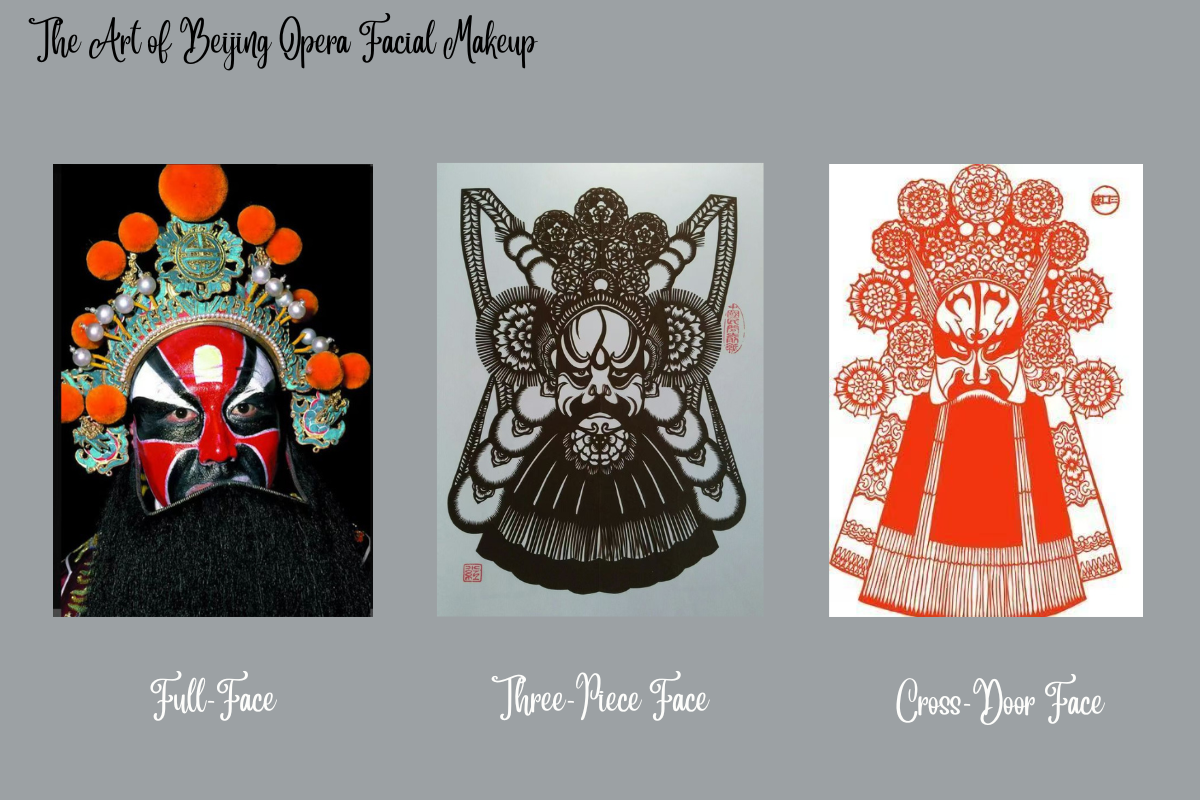
Classification of Styles:
- Full-Face: Entire face painted in a single color with detailed facial features, representing dignified figures with hidden deceit.
- Three-Piece Face: Using black or dark hues to exaggerate 夸张(kuā zhāng) eye sockets and nostrils, resembling three pieces of roof tiles, suitable for both positive and negative characters.
夸张(kuā zhāng), verb, exaggerate
Example:
- Don't exaggerate the facts.
不要夸张事实。
bú yào kuā zhāng shì shí. - His stories are always exaggerated.
他的故事总是很夸张。
tā de gù shi zǒng shì hěn kuā zhāng.
- Cross-Door Face: White base with a black pillar drawn from the nose to the forehead, a horizontal line across the black eye socket, and elliptical black dots for eyebrows, forming a cross-like pattern.
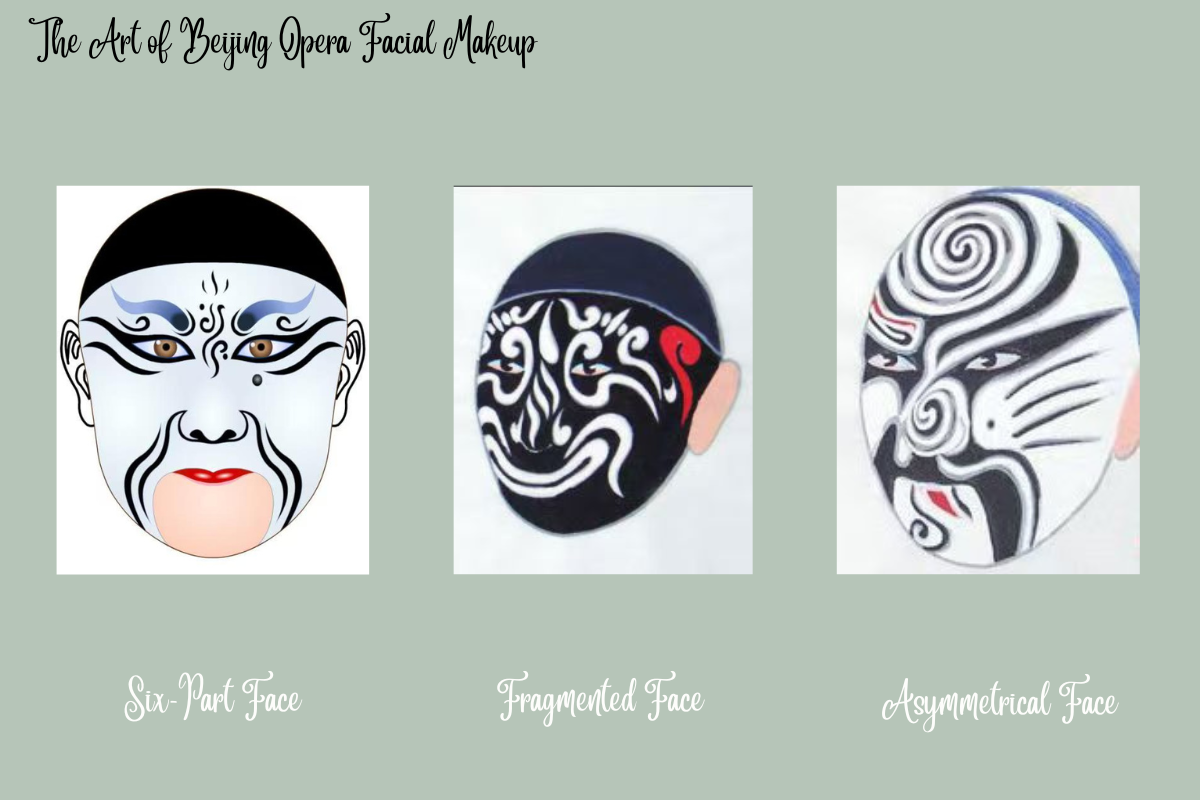
- Six-Part Face: White forehead with a dark pillar from the nose to the forehead, dark lower brows to the cheeks, showing a four to six ratio of white to dark colors.
- Fragmented Face: Evolved from full-face and three-piece styles, dividing the face into multiple sections with intricate patterns, often portraying bold and rugged characters.
- Asymmetrical Face: Discrepant layout showcasing characters with irregular features, representing ugliness or untrustworthiness.
- Representational Face: Designing facial patterns reminiscent of animals or objects based on mythological, legendary, or historical figures, such as Sun Wukong's monkey face.
Symbolic Significance
Beijing Opera facial makeup patterns embody Chinese expressive aesthetics, bearing traditional cultural codes. For instance, the white moon-shaped symbol on Bao Zheng's black face signifies "judicial authority in the underworld," reinforcing his image of justice. Zhao Kuangyin's dragon pattern on his face features only half a dragon, hinting at his status as a "true dragon emperor," embodying the balance between "divine rulership" and the philosophy of modesty.
Beijing Opera facial makeup serves not only as a stage prop but also as a visual lexicon of characters, encapsulating the Chinese philosophical expression of good and evil, beauty and ugliness.