As the New Year bell rings, the lunar Year of the Horse arrives once again. In Chinese culture, the horse is not only one of the twelve zodiac animals, but also a symbol of strength, speed, and success. In this special year, let us turn our eyes to the museum and meet a true “superstar” from the glorious Tang Dynasty — the Tang Sancai horse figurine.
The Shining “Sports Car” of the Tang Dynasty
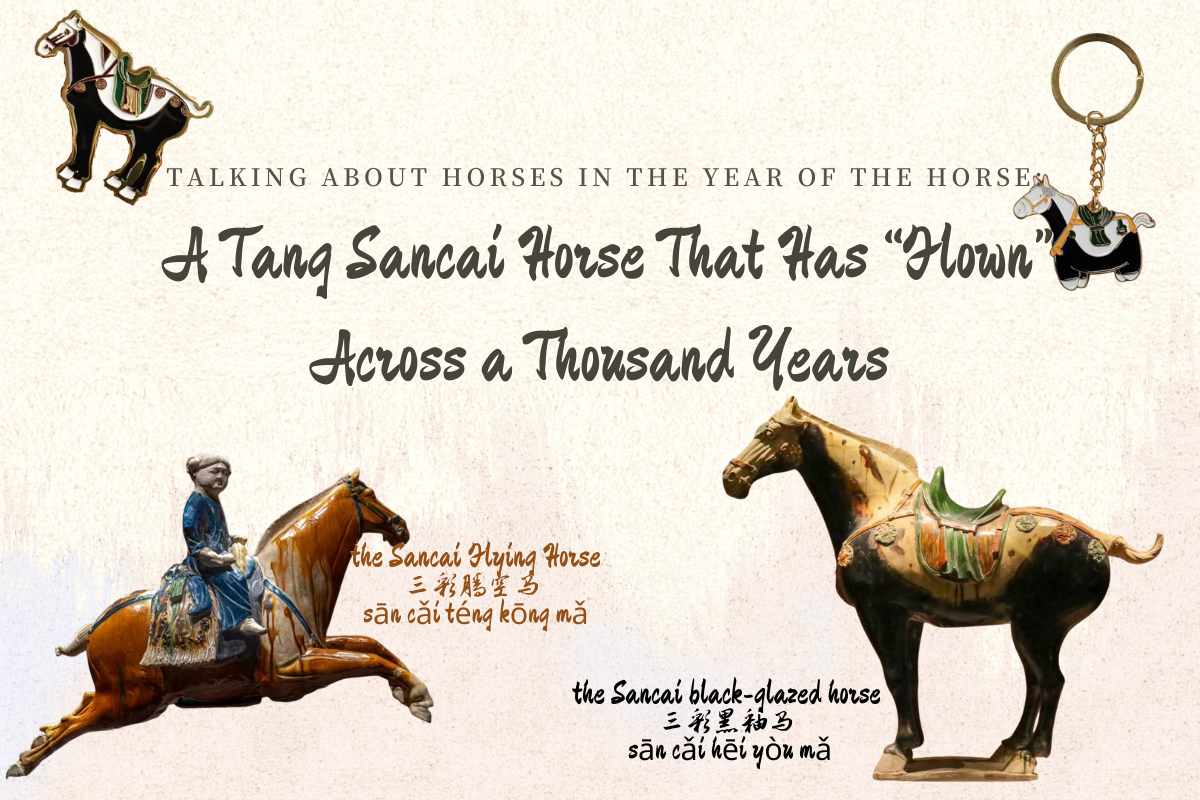
When you walk into the Xi' an Museum, one piece will surely catch your eye: the Sancai Flying Horse(三彩腾空马 sān cǎi téng kōng mǎ). Unlike the more common standing horses with all four hooves on the ground, this horse has all four hooves in the air, as if it is about to burst out of the glass case and race away with the young rider on its back.
The horse has a strong, heavy body and smooth muscle lines, showing the typical features of a fine horse from the Western Regions. The boy riding on its back wears blue clothes, has deep-set eyes, a high nose, and a confident smile. He is clearly a Hu person, someone from the Western Regions. His blue robe was made with precious cobalt-blue glaze, a pigment that had to be imported from faraway Persia through the Silk Road and was extremely valuable at the time. This horse and rider capture the lively spirit of Tang Chang' an at its height, and they also show the openness and inclusiveness of that great age.
The Rise of the “Dark Horse” and Its Fashion Makeover
Among the large family of Sancai horses, there is also a very rare kind called the black-glazed horse(黑釉马 hēi yòu mǎ). In the Tang Dynasty, it was very difficult to produce a pure black glaze, so very few of these pieces survive today. They can truly be called the “nobility among horses.” One Tang Sancai black-glazed horse in the Luoyang Museum is almost completely black, with only its face, mane, and four hooves in white. In elegant traditional language, this is called “four hooves treading on snow“(四蹄踏雪 sì tí tà xuě).”
Today, these cultural relics that have “slept” for a thousand years are going through a wonderful transformation. Based on the Sancai black-glazed horse(三彩黑釉马 sān cǎi hēi yòu mǎ) in the National Museum of China, a series of cultural and creative products called “A Black Horse” has become extremely popular. The once solemn and dignified artifact has been turned into adorable fridge magnets, delicate necklaces, and even transformable mecha toys. This charming contrast has allowed ancient Tang Sancai art to instantly connect with modern people, helping them feel the appeal of traditional culture while enjoying these creative designs.
Language Mini-Class: Learn Chinese in the Year of the Horse
Since this year is the Year of the Horse and we have learned about the Tang Tri-color Glazed Pottery Terracotta Warriors, why not learn two Chinese words related to horses? Let's have a deeper understanding of Chinese culture.
马上(mǎ shàng)
Meaning: the literal meaning is "on the horse", but in spoken language, its most commonly used meaning is "immediately" or "right away".
Example:
- 我马上到!
wǒ mǎ shàng dào!
I'll be there right away! - 饭马上就好。
fàn mǎ shàng jiù hǎo.
The food will be ready in a moment.
龙马精神(lóng mǎ jīng shén)
Meaning: The dragon represents nobility and the horse represents vitality. This word is used to bless others to be energetic and full of vitality, like dragons and horses.
Example:
- 祝你龙马精神!
zhù nǐ lóng mǎ jīng shén!
Wish you the spirit of a dragon and horse! - 爷爷每天都锻炼,真是龙马精神。
yé ye měi tiān dōu duàn liàn, zhēn shi lóng mǎ jīng shén.
Grandpa exercises every day, he really has the spirit of a dragon and horse!
The Tang Sancai horse figurines are not just artworks made of clay. They are also “living fossils” of the Silk Road. From the Ferghana horses presented as tribute from the Western Regions, to the Hu youth seen on the streets of Chang’an, to the flowing colorful glazes in the hands of craftsmen, every Sancai horse carries a story that crossed mountains and seas. Standing there quietly, they tell the world about the glorious Tang Dynasty — a brilliant age that embraced many cultures and welcomed people from all nations.