In Chinese culture, horses are not just tools for travel or farm animals. They are heroes, companions in battle, and even symbols with a myth-like status. This year is the Year of the Horse, so let’s travel through time and meet two “super horses” that are very famous in Chinese history. Their stories reflect the Chinese love of heroism and romance.
The “Heavenly Horse” on the Silk Road: Ferghana horse (汗血宝马 hàn xuè bǎo mǎ)
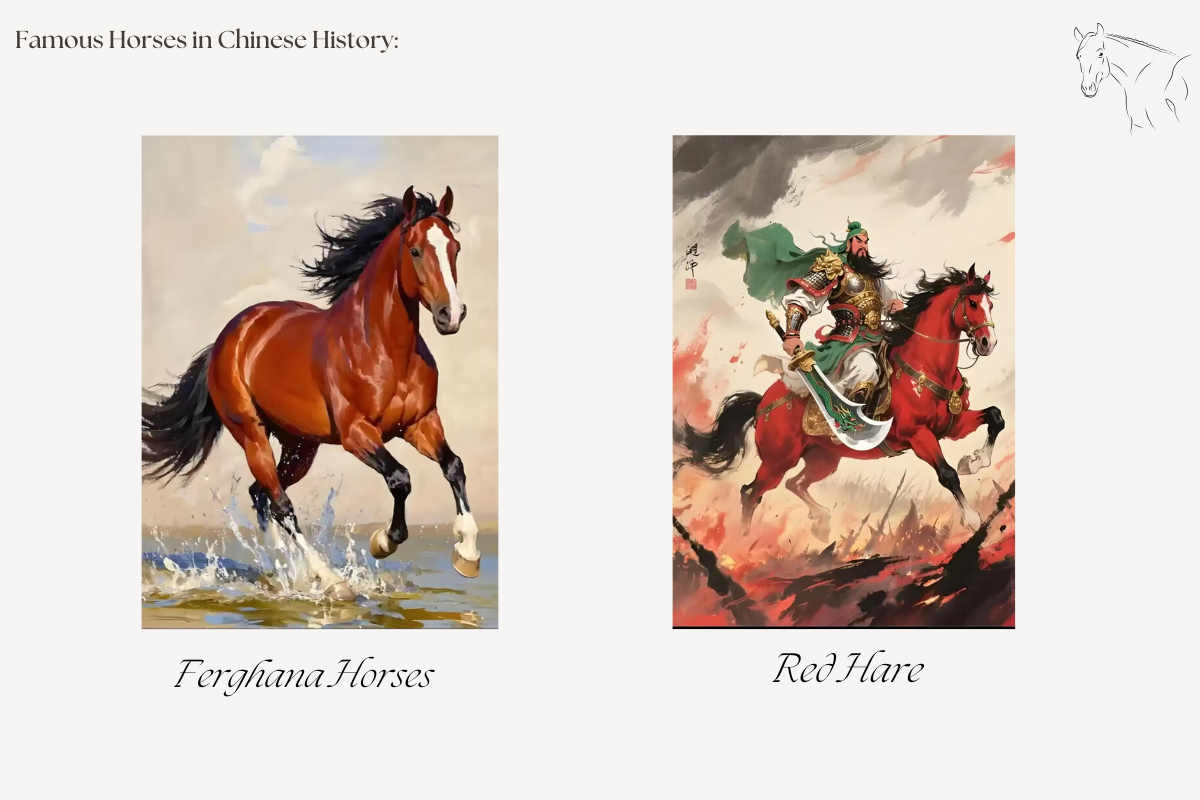
Imagine this: more than 2,000 years ago, during the Han Dynasty, Emperor Wu of Han heard about a special kind of horse in the Western Regions (today’s Central Asia). These horses were said to run as fast as the wind. Even more amazingly, when they ran, red sweat that looked like blood seemed to appear on their shoulders. Because of this, they were called 汗血宝马 (hàn xuè bǎo mǎ, “blood-sweating precious horses”).
To get these fine horses, Emperor Wu of Han even sent out a large army. After many hardships, the horses were finally brought back to central China. In the eyes of ancient people, they were like “天马(tiān mǎ, “heavenly horses”)" sent down from the sky.
In fact, the so-called “blood sweat” was not real blood. Scientists believe it may have happened because the horses had very thin skin, and their blood vessels expanded while running, making them look red in the sunlight. Another possible reason is a skin reaction caused by parasites. But this does not change their noble image. 汗血宝马 (hàn xuè bǎo mǎ) were important messengers of cultural exchange along the Silk Road. They were strong and had great endurance. They helped improve the fighting power of the Han army and also helped connect Eastern and Western civilizations.
Today, the Ferghana horse (汗血宝马, hàn xuè bǎo mǎ) is still a national treasure in Turkmenistan and is seen as a “moving treasure.” In China, it is also a symbol of strength and glory, and it represents the rising spirit of "龙马精神 (lóng mǎ jīng shén, the spirit of vigor, strength, and ambition)".
A Symbol of Loyalty and Righteousness: Guan Yu’s Red Hare(赤兔马, chì tù mǎ)
If the Ferghana horse stands for “imperial power and national destiny,” then Red Hare(赤兔马 chì tù mǎ) stands for “loyalty, righteousness, and heroism.”
If you have read Romance of the Three Kingdoms or played related games, you have probably heard of Lü Bu and Guan Yu. Red Hare first belonged to Lü Bu. Its whole body was fiery red, with not a single mixed hair. It was tall, powerful, could travel a thousand li in a day, and could cross water as if it were walking on flat land. It was praised as “马中赤兔” (mǎ zhōng chì tù, “the Red Hare among horses”).
Later, Cao Cao gave this famous horse to Guan Yu in order to win him over. From then on, Red Hare was always by the side of Guan Yu, who was later honored as the “God of War.” It accompanied him as he "过五关斩六将(guò wǔ guān zhǎn liù jiàng, “passed five passes and slew six generals”)" , and helped him take enemy generals’ heads from the middle of huge armies. After Guan Yu was defeated in Maicheng and died, Red Hare also died by refusing food—at least, that is how the story is told in the novel.
In Chinese eyes, Red Hare is no longer just a warhorse. It is a symbol of loyalty, faithfulness, and courage. People often say "人中吕布,马中赤兔 (rén zhōng lǚ bù, mǎ zhōng chì tù)", which means: among people, Lü Bu is outstanding; among horses, Red Hare is the finest. It is used to describe a person or thing that is exceptionally excellent.
The Special Place of Horses in Chinese Culture
From the bronze chariot and horses of the Mausoleum of Qin Shi Huang to the running horses painted by Xu Beihong, the image of the horse runs through Chinese history.
In ancient times, horses were the main force in war and the fastest means of movement. In Chinese poetry, the horse appears in lines full of style and spirit. It can be the confidence and joy of "春风得意马蹄疾(chūn fēng dé yì mǎ tí jí)", or the power and boldness of "金戈铁马(jīn gē tiě mǎ)". For Chinese people, the horse represents a spirit of moving forward bravely and never giving up.
Mini Language Class: Useful Chinese Words About Horses
Now that you know the stories, let’s learn a few useful Chinese expressions about horses, so that in the Year of the Horse you can also go full speed ahead!
马到成功(mǎ dào chéng gōng)
- Meaning:
A victory is won as soon as the warhorse arrives. It means things go smoothly and success comes right at the beginning. This is a very good blessing to give someone. - Example:
祝你在这次项目中马到成功!
zhù nǐ zài zhè cì xiàng mù zhōng mǎ dào chéng gōng!
Wishing you immediate success in this project!
千里马 (qiān lǐ mǎ)
- Meaning: Originally, it meant a fine horse that could run a thousand li. Now it is often used to describe a talented person with great ability and potential.
- Example:
他是老板眼中的千里马,非常受重用。
tā shì lǎo bǎn yǎn zhōng de qiān lǐ mǎ, fēi cháng shòu zhòng yòng.
In the boss’s eyes, he is a real talent and is highly valued.
拍马屁 (pāi mǎ pì)
- Meaning:
This is a very interesting saying. It originally meant patting a horse on the rear to make it feel comfortable. Now it means saying nice things to please someone, or “flattering” them. - Note: This word has a slightly negative meaning, so be careful when using it.
- Example:
他很喜欢拍马屁,老板说什么他都叫好。
tā hěn xǐ huān pāi mǎ pì, lǎo bǎn shuō shén me tā dōu jiào hǎo.
He loves flattering people. Whatever the boss says, he always agrees.
老马识途(lǎo mǎ shí tú)
- Meaning:
An old horse knows the way. It means an experienced person understands the situation well and can guide others. It describes someone with rich experience. - Example:
这个问题还得请教张工,毕竟老马识途嘛。
zhè ge wèn tí hái děi qǐng jiào Zhāng gōng, bì jìng lǎo mǎ shí tú ma.
We still need to ask Engineer Zhang about this issue—after all, an experienced person knows the way.
I hope these stories and words help you better understand Chinese horse culture. In this Year of the Horse, may you be as energetic as the Ferghana horse (汗血宝马 hàn xuè bǎo mǎ), as loyal and brave as Red Hare(赤兔马 chì tù mǎ), and may everything you do be 马到成功(mǎ dào chéng gōng) !