
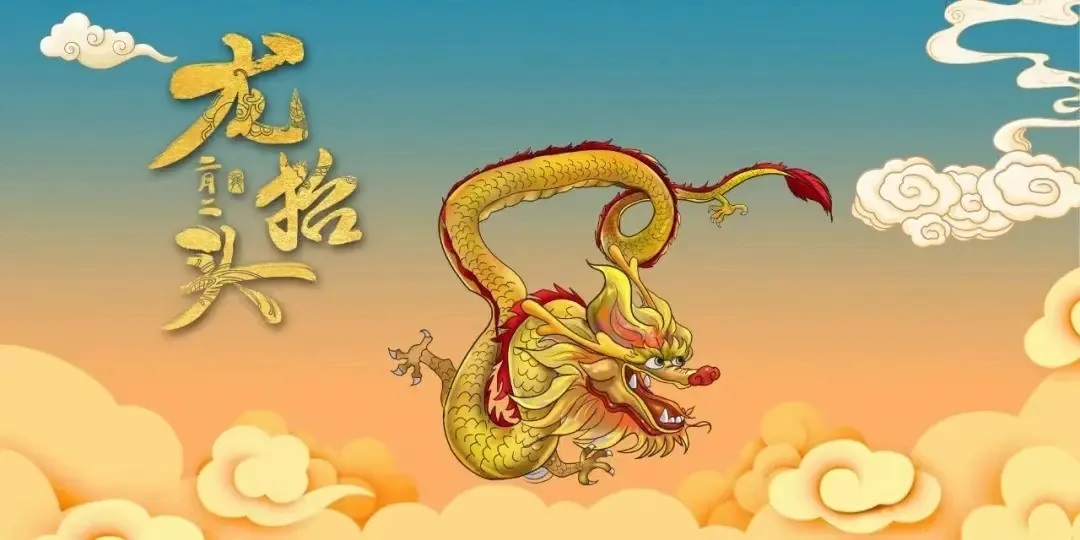
Dragon-Head-Raising Festival

Tuesday, February 21, 2023

The origin of Dragon Heads-raising Day
Chinese folklore says that every second day of the second lunar month is the time when the dragon in charge of the rain lifts its head. Thereafter, the rain will gradually increase, indicating a good harvest this year. The folk proverb "On February 2, the dragon lifts its head, the big barn is full, and the small barn flows" is widely spread in the north of China. This day is called "Spring Dragon Festival", also known as "Spring Farming Festival". Since about the Tang Dynasty, Chinese people have had the custom of "February 2". Chinese people believe that dragons are auspicious, responsible for clouds and rain, and the day of February 2 in the lunar calendar is the day when dragons want to ascend to heaven.  In terms of solar terms, at the beginning of February in the lunar calendar, it is between "The rains", "the Waking of Insects" and "Vernal Equinox". Many places in China have begun to enter the rainy season, which is a natural law, but the ancients believed that this is the credit of "dragon". Moreover, the dragon has a high position in the minds of the Chinese people. It is not only a mascot, but also the master of weathering rain. Therefore, there was "February 2".

The custom of Dragon Heads-raising Day
This day's haircut is called "Shaving the head"  Bless the children to grow up healthily and become famous when they grow up. Adults cut their hair and welcome the new year, hoping to bring good luck. There is a folk saying that "if you shave your head on February 2, you will be full of energy the whole year".

The food on Dragon Heads-raising Day
For the sake of Naji, the food eaten by northerners on this day is named after "dragon". Noodles are not called "noodles", but "dragon whiskers noodles"; Dumplings are called "dragon ears" and "dragon horns"; Rice is called "dragon" and so on. Everything takes the symbol and implication related to the dragon.


Sign up for a free trial now!

FAQ / Tips

We offer secure and convenient payment options, including PayPal. PayPal is a widely recognized and trusted online payment platform that provides a secure way to make transactions. We also follow industry-standard security protocols to ensure the safety of your personal and financial information.
Thank you for choosing Chinese Learning for your language learning needs.If you need to cancel or reschedule a lesson, please do so at least 4 hours ahead of time. To request a cancellation, please send an email to ivy.wang @chineselearning.com or service @chineselearning.com.We appreciate your cooperation and understanding, and we look forward to providing you with the best learning experience possible."
We offer highly flexible class schedules that cater to your needs, with lessons available from 7am to 10pm Beijing time, seven days a week.This allows you to conveniently take lessons at any time and from any location that suits your schedule.
At Chinese Learning, protecting our customers' personal information is a top priority. We have implemented robust security measures to safeguard your data and prevent any unauthorized access or disclosure. For further information on our privacy practices, please refer to our Privacy Policy, which outlines our commitment to data protection and privacy.
Our students come from a wide range of ages, from 3 years old to over 80 years old. Our courses are tailored to each student's age and proficiency level to ensure they can receive maximum benefit and progress. Whether you want to learn Chinese as a second language or improve your existing Chinese skills, we can provide you with courses and resources that are suitable for you
Our instructors are highly skilled and experienced experts in Chinese language teaching, with proficiency in multiple languages. They hold at least a bachelor's degree in teaching Chinese as a foreign language, and possess extensive teaching experience and knowledge. Through a rigorous selection process and ongoing training, our instructors are equipped to provide students with authentic pronunciation, accurate language usage, and cultural background knowledge, all of which are essential for achieving mastery of the Chinese language.