
When Chinese people feel unwell, they often use concise and vivid vocabulary to describe their symptoms. Understanding these key terms will help you better understand their condition and communicate effectively.

Stomach Discomfort
胃疼 (wèi téng) ,stomach pain
Explanation: Refers to pain or discomfort in the stomach area.
Example Sentences:
- 我昨晚吃太多了,现在有点胃疼。
wǒ zuó wǎn chī tài duō le, xiàn zài yǒu diǎn wèi téng.
I ate too much last night, and now I have a bit of a stomach ache. - 他胃疼得厉害,得去看医生。
tā wèi téng de lì hài, děi qù kàn yī shēng.
He has a terrible stomach ache and needs to see a doctor.
肚子疼 (dù zi téng), abdominal pain
Explanation: A more general term for pain in the entire abdomen, including the stomach and intestines. It is used more widely than "胃疼."
Example Sentences:
- 我可能吃坏东西了,肚子疼。
wǒ kě néng chī huài dōng xī le, dù zi téng.
I might have eaten something bad; my stomach hurts. - 小朋友哭着说肚子疼。
xiǎo péng yǒu kū zhe shuō dù zi téng.
The child cried and said his stomach hurts.
Head Discomfort
头疼 (tóu téng), headache
Explanation: Refers to pain in the head, which can range from mild discomfort to severe pain.
Example Sentences:
- 工作压力大,我经常头疼。
gōng zuò yā lì dà, wǒ jīng cháng tóu téng.
I often have headaches due to work stress. - 我有点头疼,想休息一下。
wǒ yǒu diǎn tóu téng, xiǎng xiū xí yī xià.
I have a slight headache and want to rest a bit.
头晕 (tóu yūn) , dizziness
Explanation: Refers to feeling faint or dizzy, feeling like oneself or the surroundings are spinning, and having difficulty standing.
Example Sentences:
- 我突然站起来会觉得头晕。
wǒ tú rán zhàn qǐ lái huì jué dé tóu yūn.
I feel dizzy when I suddenly stand up. - 他发烧了,浑身无力还头晕。
tā fā shāo le, hùn shēn wú lì hái tóu yūn.
He has a fever, feels weak all over, and is also dizzy.
Cold and Systemic Symptoms
感冒 (gǎn mào), cold
Explanation: Refers to catching a cold, one of the most common illnesses.
Example Sentences:
- 天气变冷了,小心别感冒。
tiān qì biàn lěng le, xiǎo xīn bié gǎn mào.
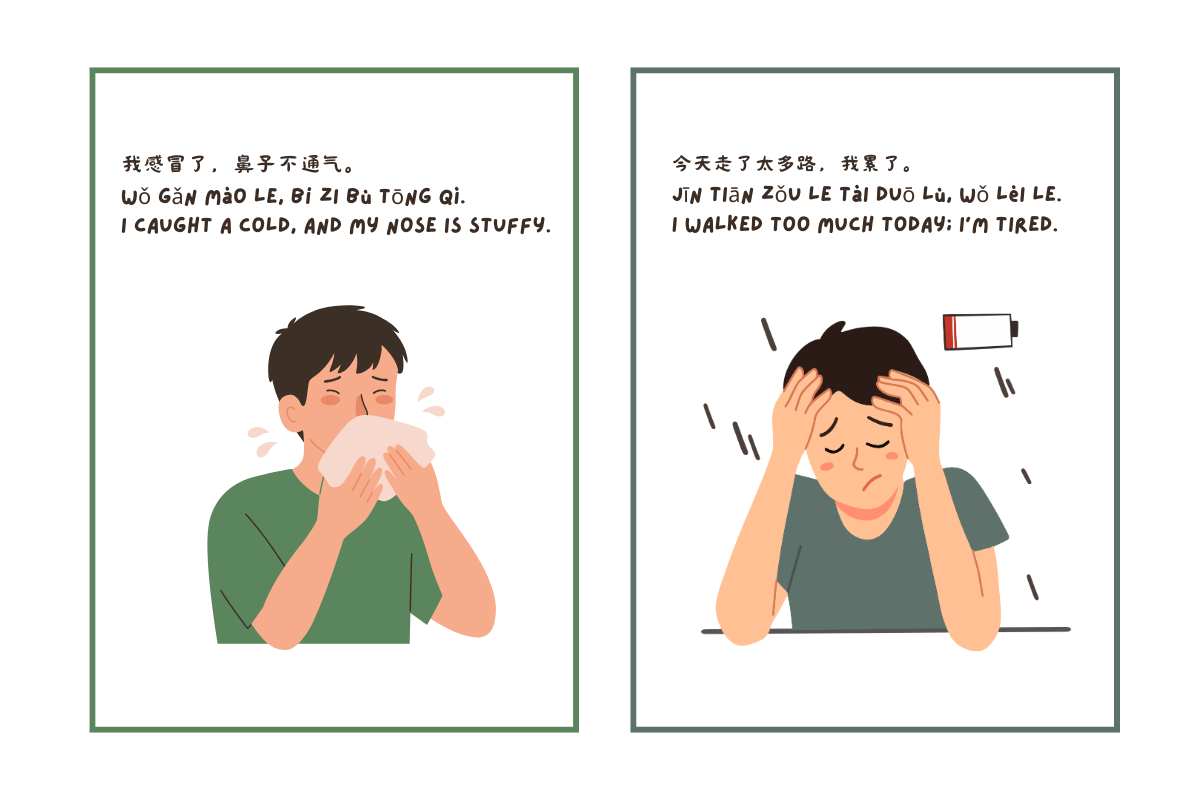
The weather has turned cold; be careful not to catch a cold. - 我感冒了,鼻子不通气。
wǒ gǎn mào le, bí zi bù tōng qì.
I caught a cold, and my nose is stuffy.
发烧 (fā shāo), fever
Explanation: Refers to an elevated body temperature beyond the normal range.
Example Sentences:
- 你额头很烫,是不是发烧了?
nǐ é tóu hěn tàng, shì bù shì fā shāo le?
Your forehead is very hot; do you have a fever? - 孩子发烧到38.5度了。
hái zi fā shāo dào 38.5 dù le.
The child has a fever of 38.5 degrees.
咳嗽 (ké sòu), cough
Explanation: Refers to a sudden expulsion of air from the throat or windpipe, producing sound when the throat or airway is irritated.
Example Sentences:
- 他感冒好了,但还在咳嗽。
tā gǎn mào hǎo le, dàn hái zài ké sòu.
He has recovered from his cold but is still coughing. - 请捂住嘴咳嗽。
qǐng wǔ zhù zuǐ ké sòu.
Please cover your mouth when you cough.
Fatigue and Mental State
累了 (lèi le), tired
Explanation: Indicates physical or mental fatigue. This term is used very frequently.
Example Sentences:
- 今天走了太多路,我累了。
jīn tiān zǒu le tài duō lù, wǒ lèi le.
I walked too much today; I'm tired. - 你看起来累了,早点休息吧。
nǐ kàn qǐ lái lèi le, zǎo diǎn xiū xí ba.
You look tired; you should rest early.
上火了 (shàng huǒ le), overheated
Explanation: A traditional Chinese medicine concept, indicating an imbalance of yin and yang in the body, leading to symptoms such as sore throat, dry mouth, acne, and swollen gums. It is often related to diet (like fried food) or stress.
Example Sentences:
- 我最近吃了太多火锅,上火了,嘴里长了溃疡。
wǒ zuì jìn chī le tài duō huǒ guō, shàng huǒ le, zuǐ lǐ zhǎng le kuì yáng.
I’ve eaten too much hot pot recently; I'm overheated and have ulcers in my mouth." - 喝点菊花茶可以帮你下火。
hē diǎn jú huā chá kě yǐ bāng nǐ xià huǒ.
Drinking some chrysanthemum tea can help cool you down.
Now that we've covered some key expressions, here’s a little tip! When you hear a friend say these terms, you can respond with a simple, “多喝水,多休息。” (duō hē shuǐ, duō xiū xi.) — This is one of the most common ways for Chinese people to express concern.