
Conversations between neighbors are usually friendly, casual, and full of life. This is a great way to learn Chinese because you can pick up the most authentic and lively everyday expressions. Below, I will simulate several common neighborly dialogue scenarios, along with detailed explanations and "learning points" to help you learn practical Chinese.
Scenario 1: Meeting in the Elevator/Hallway
This is the most common scenario, and the dialogue is usually short, focusing on greetings.
Dialogue:
You: 张阿姨,出去啊?
zhāng ā yí, chū qù a?
Hey, Aunt Zhang, heading out?
Neighbor: 哎,去买点菜。你刚下班?
āi, qù mǎi diǎn cài. nǐ gāng xià bān?
Ah, I’m going to buy some groceries. Did you just get off work?
You: 对。今天天气真不错。
duì. jīn tiān tiān qì zhēn bú cuò.
Yes. The weather is really nice today.
Neighbor: 是啊,挺暖和的。我先走了啊。
shì a, tǐng nuǎn huo de. wǒ xiān zǒu le a.
Yeah, it’s quite warm. I’ll be on my way.
You: 好,您慢点。
hǎo, nín màn diǎn.
Okay, take your time.
Learning Points:
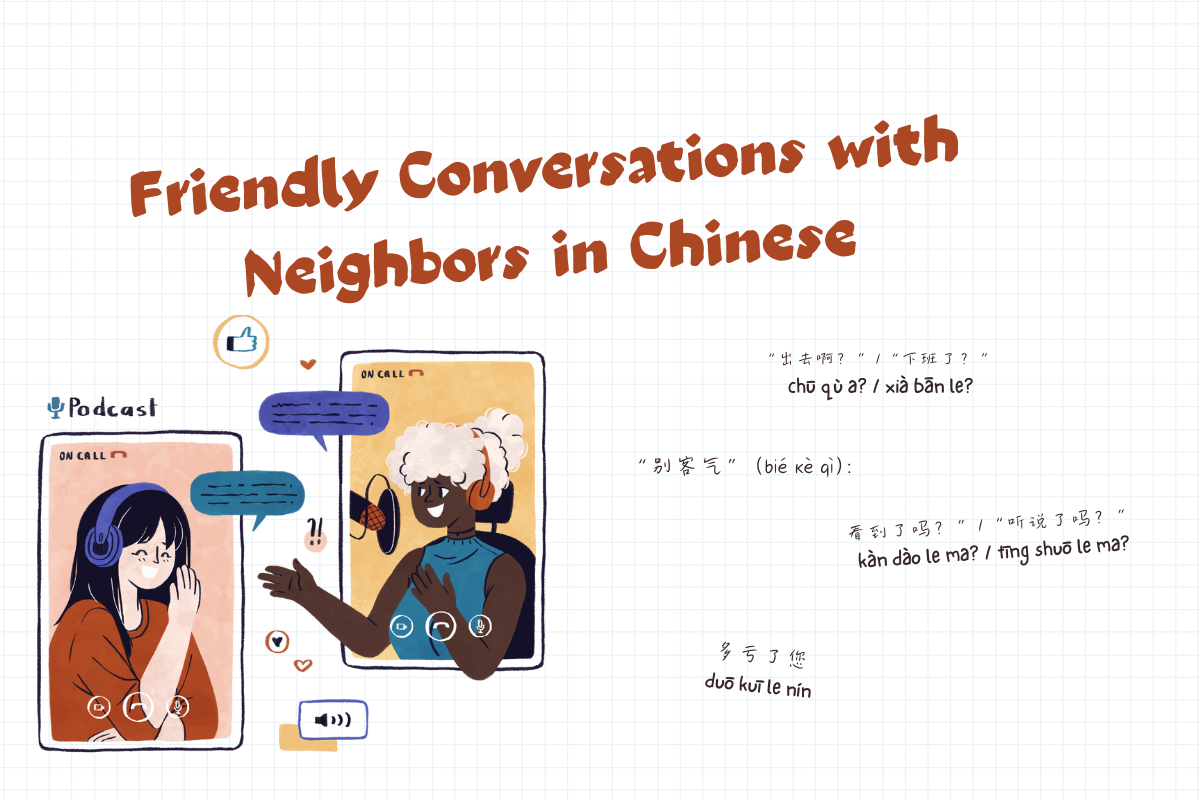
- “出去啊?”/“下班了?”
chū qù a? / xià bān le?:
These are not real questions but friendly greetings, similar to "Heading out?" in English. A simple affirmative response is enough. - “哎” (āi):
A very common particle used for greetings or responses, making the conversation feel warm and natural. - “您” (nín):
Use “您” for elders or to show respect, while “你” is for peers or younger people. Using “您” for Aunt Zhang shows politeness. - “慢点” (màn diǎn):
A warm farewell phrase meaning "take it slow" or "be careful," showing concern. It feels more heartfelt than just saying "goodbye."
Scenario 2: Picking Up a Package
Dialogue:
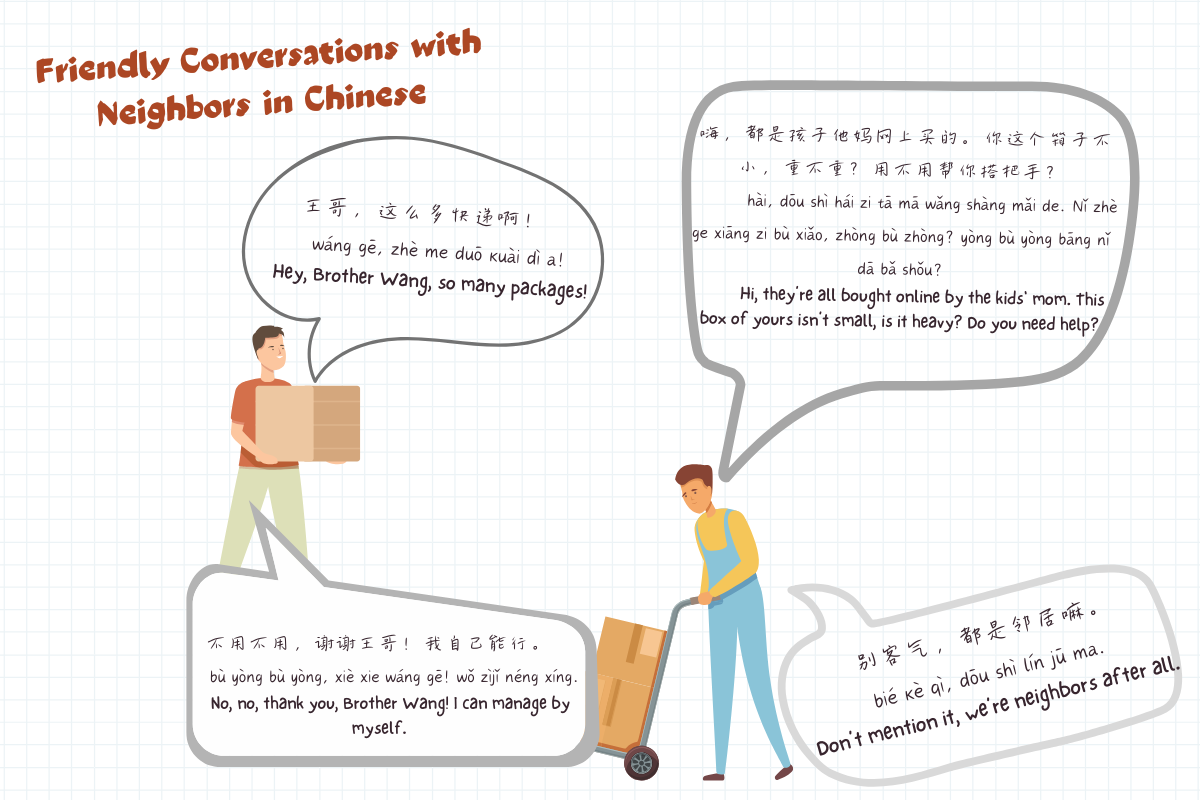
You: 王哥,这么多快递啊!
wáng gē, zhè me duō kuài dì a!
Hey, Brother Wang, so many packages!
Neighbor: 嗨,都是孩子他妈网上买的。你这个箱子不小,重不重?用不用帮你搭把手?
hài, dōu shì hái zi tā mā wǎng shàng mǎi de. Nǐ zhè ge xiāng zi bù xiǎo, zhòng bù zhòng? yòng bù yòng bāng nǐ dā bǎ shǒu?
Hi, they’re all bought online by the kids' mom. This box of yours isn’t small, is it heavy? Do you need help?
You: 不用不用,谢谢王哥!我自己能行。
bù yòng bù yòng, xiè xie wáng gē! wǒ zìjǐ néng xíng.
No, no, thank you, Brother Wang! I can manage by myself.
Neighbor: 别客气,都是邻居嘛。
bié kè qì, dōu shì lín jū ma.
Don’t mention it, we’re neighbors after all.
Learning Points:
- “王哥”/“张阿姨” (wáng gē / zhāng ā yí):
Using “surname + brother/sister/aunt” to address neighbors is very common and friendly, quickly building rapport. - “嗨” (hài):
Here, it doesn’t mean "hello," but is an exclamation often used to express a sense of "don’t mention it" or "that’s how it is," with a hint of resignation or self-deprecation. - “搭把手” (dā bǎ shǒu):
A colloquial expression meaning "to lend a hand." It's more casual than saying "help." - “别客气” (bié kè qì):
When someone thanks you, you can say "You're welcome" or "Don’t mention it." Here, the neighbor anticipates your thanks and says "Don’t mention it" first, showing warmth.
Scenario 3: Community Notice (e.g., Water or Power Outage)
Dialogue:
Neighbor: 小李,看到楼下贴的通知了吗?明天上午要停水。
xiǎo lǐ, kàn dào lóu xià tiē de tōng zhī le ma? míng tiān shàng wǔ yào tíng shuǐ.
Xiao Li, did you see the notice downstairs? They’re going to cut off the water tomorrow morning.
You: 是吗?我没注意。停到几点啊?
shì ma? wǒ méi zhù yì. tíng dào jǐ diǎn a?
Really? I didn’t notice. Until what time?
Neighbor: 说是从早上八点到中午十二点。你记得提前接点水。
shuō shì cóng zǎo shang bā diǎn dào zhōng wǔ shí èr diǎn. nǐ jì de tí qián jiē diǎn shuǐ.
They said from 8 AM to 12 PM. Remember to fill up some water in advance.
You: 好的,谢谢您提醒!您家接好了吗?
hǎo de, xiè xie nín tí xǐng! nín jiā jiē hǎo le ma?
Okay, thank you for the reminder! Is your place ready?
Neighbor: 接好了接好了。
jiē hǎo le jiē hǎo le.
Yes, we’re all set.
Learning Points:
- “看到了吗?”/“听说了吗?”
kàn dào le ma? / tīng shuō le ma?:
Common phrases to start a topic, equivalent to "Did you see/hear about...?" - “说是...” (shuō shì...):
Means "the notice says..." or "it’s said that...," used to convey third-party information. Very practical. - “接点水” (jiē diǎn shuǐ):
"接水" is a fixed phrase meaning to store water using a container. - “好了” (hǎo le):
Here, it indicates completion, meaning "it’s all ready." "接好了" means "the water has been filled."
Scenario 4: Borrowing Things or Asking for a Small Favor
Dialogue:
You: 刘奶奶,您家有螺丝刀吗?我想借一下。
liú nǎi nai, nín jiā yǒu luó sī dāo ma? wǒ xiǎng jiè yī xià.
Grandma Liu, do you have a screwdriver? I’d like to borrow it.
Neighbor: 有,你等着,我给你拿去。要修什么呀?
yǒu, nǐ děng zhe, wǒ gěi nǐ ná qù. yào xiū shén me ya?
Yes, wait a moment, I’ll get it for you. What are you fixing?
You: 椅子有点松了,紧一紧。太感谢您了!
yǐ zi yǒu diǎn sōng le, jǐn yī jǐn. tài gǎn xiè nín le!
The chair is a bit loose, so I need to tighten it. Thank you so much!
Neighbor: 没事儿,用完再还我就行。
méi shì er, yòng wán zài huán wǒ jiù xíng.
No problem, just return it after you’re done.
(After using it)
You: 刘奶奶,还您螺丝刀,多亏了您。
liú nǎi nai, huán nín luó sī dāo, duō kuī le nín.
Grandma Liu, here’s your screwdriver back, thanks to you.
Neighbor: 修好了就行。
xiū hǎo le jiù xíng.
As long as it's fixed, that’s fine.
Learning Points:
- “借一下” (jiè yī xià):
"一下" makes the request softer and less abrupt. Saying "I want to borrow a screwdriver" sounds harsh; "borrow一下" feels much better. - “紧一紧” (jǐn yī jǐn):
"紧" is an adjective but used as a verb here, meaning "to tighten." Many adjectives can be used this way in Chinese, like "干净一下" (clean up a bit). - “多亏了您” (duō kuī le nín):
A very authentic way to express gratitude, meaning "thanks to your help," which carries more emotion than just "thank you." - “没事儿” (méi shì er):
A very colloquial way to say "you’re welcome," "no problem," or "it’s okay." A versatile expression.
Next time you see your neighbors, don’t be shy! Use the sentences you’ve learned. Even just saying "出去啊?" will make them happy, and they’ll usually respond positively. Happy learning and enjoy your interactions with your neighbors!