
In daily transactions, Chinese people use a rich variety of expressions, encompassing traditional cash payment terms alongside swiftly adopted vernacular related to mobile payment trends. These terms are typically concise, straightforward, and sometimes carry industry or regional characteristics.
Payment Method Related Terms
Cash Payment
This is the most traditional payment method, and the related terms are quite direct.
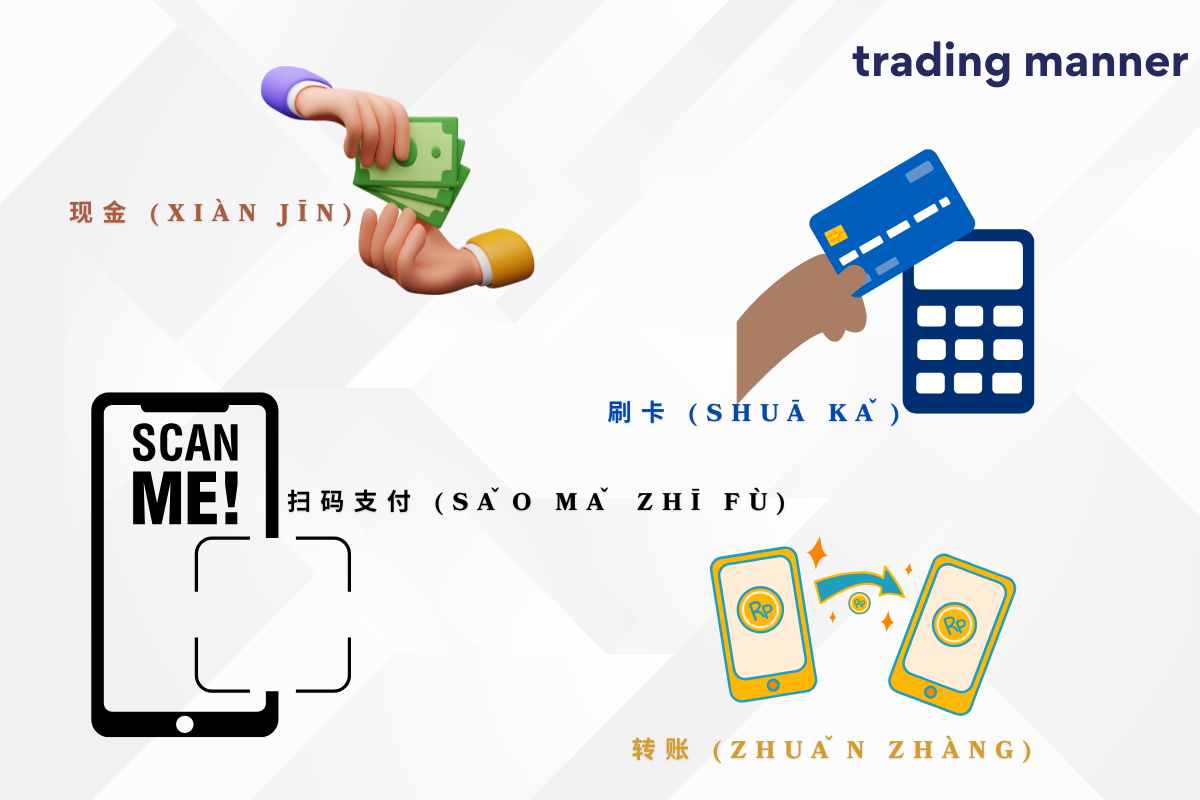
- 现金 (xiàn jīn): The standard term.
- 现钱 (xiàn qián): Informal term, meaning the same as "cash."
- 零钱 (líng qián): Small denomination paper bills or coins.
- 整钱 (zhěng qián): Large denomination bills (like 100 yuan).
- 找零 (zhǎo líng): Referring to returned coins.
Examples:
- "请问您有零钱吗?我找不开。"
qǐng wèn nín yǒu líng qián ma? wǒ zhǎo bu kāi.
"Do you have any change? I can't make change."
- "不好意思,零钱不够了,我扫码支付吧。"
bù hǎo yì si, líng qián bù gòu le, wǒ sǎo mǎ zhī fù ba.
"Sorry, I'm short on change, let's use scan-to-pay."
- "收您100,找您25,您数好。"
shōu nín yī bǎi, zhǎo nín èr shí wǔ, nín shǔ hǎo.
"I will take 100 from you, and give you back 25, please count it."
Mobile Payment
This is currently the most mainstream payment method in China, with very colloquial language usage.
- 扫码支付 (sǎo mǎ zhī fù) / 扫一扫 (sǎo yī sǎo): The most common terms.
- 扫码 (sǎo mǎ): Scanning QR codes.
- 付款码 (fù kuǎn mǎ): Presented by customers, scanned by businesses to deduct payment.
- 收款码 (shōu kuǎn mǎ): Presented by businesses for customers to scan for transferring funds.
- 微信支付 (wēi xìn zhī fù): One of the most common terms, often shortened to "WeChat."
- 支付宝 (zhī fù bǎo): Another popular term.
- 刷手机 (shuā shǒu jī): Very colloquial, referring to mobile payment in general.
Examples:
- 您扫我,还是我扫您?
nín sǎo wǒ, hái shi wǒ sǎo nín?
"Do you scan me, or should I scan you?"
("This is the most common question during payment, asking whether the business scans the customer's payment code or the customer scans the business's receiving code.")
- "您好,请出示一下付款码。"
nín hǎo, qǐng chū shì yī xià fù kuǎn mǎ.
"Hello, please present your payment code."
- "墙上有收款码,您直接扫那个就行。"
qiáng shàng yǒu shōu kuǎn mǎ, nín zhí jiē sǎo nà ge jiù xíng.
"There's a receiving code on the wall, just scan that one."
- "老板,微信(支付)可以吗?"
lǎo bǎn, wēi xìn (zhī fù) kě yǐ ma?
"Boss, can I use WeChat (pay)?"
- "我们用微信转给你。"
wǒ men yòng wēi xìn zhuǎn gěi nǐ.
"We'll transfer through WeChat."
- "我用支付宝付。"
wǒ yòng zhī fù bǎo fù.
I'll pay with Alipay.
- "没带现金,刷手机吧。"
méi dài xiàn jīn, shuā shǒu jī ba.
"I don't have cash, let's use mobile payment."
Bank Card / Credit Card Payment
- 刷卡 (shuā kǎ): Generally using bank cards (including debit and credit cards) for payment.
- 闪付 (shǎn fù): Specifically referring to bank cards with QuickPass for contactless payments.
- POS机 (POS jī): The machine used for card payments.
Examples:
- "能刷卡吗?"
néng shuā kǎ ma?
"Can I swipe my card?"
- "麻烦您在这里输入一下密码。"
má fan nín zài zhèlǐ shū rù yī xià mì mǎ.
"Could you please enter your PIN here?"
Money Transfer
- 转账 (zhuǎn zhàng): Universal term.
- 转钱 (zhuǎn qián): Very colloquial term.
Examples:
- "我把钱转给你。"
wǒ bǎ qián zhuǎn gěi nǐ.
"I'll transfer the money to you."
- "AA制吧,我等下把钱转你微信。"
AA zhì ba, wǒ děng xià bǎ qián zhuǎn nǐ wēi xìn.
"Let's go Dutch, I'll transfer the money to your WeChat later."
Transactional Process Related Terms
Buyer Common Phrases:
- 多少钱?
duō shǎo qián?
How much?
- 怎么卖?
zěn me mài?
What's the price? (Inquiring about cost.)
- 便宜点吧。
pián yi diǎn ba.
Can you make it cheaper?
- 能优惠吗?
néng yōu huì ma?
Any discount? (Bargaining.)
- 包邮吗?
bāo yóu ma?
Free shipping? (When online shopping, asking about free delivery.)
- 开发票吗?
kāi fā piào ma?
Need an invoice? (Asking if an invoice can be provided.)
- 开普票还是专票?
kāi pǔ piào hái shi zhuān piào?
Do you need a regular invoice or a VAT invoice? (Asking for a regular invoice or a value-added tax invoice.)
- 有现货吗?
yǒu xiàn huò ma?
Is it in stock? (Inquiring about availability.)
Seller Common Phrases:
- 收您XX元。
shōu nín XX yuán.
It's XX yuan. (Informing of the amount to be paid.)
- 一共是XX元。
yī gòng shì XX yuán.
The total is XX yuan. (Indicating the total price.)
- 请问怎么支付?
qǐng wèn zěn me zhī fù?
How will you pay? (Asking about payment method.)
- 稍等,给您小票。
shāo děng, gěi nín xiǎo piào.
Wait a moment, here's your receipt. (Providing a receipt after the transaction.)
- 慢走,下次再来!
màn zǒu, xià cì zài lái!
Take care, come back next time! (Polite farewell to the customer.)
Dialogue Examples
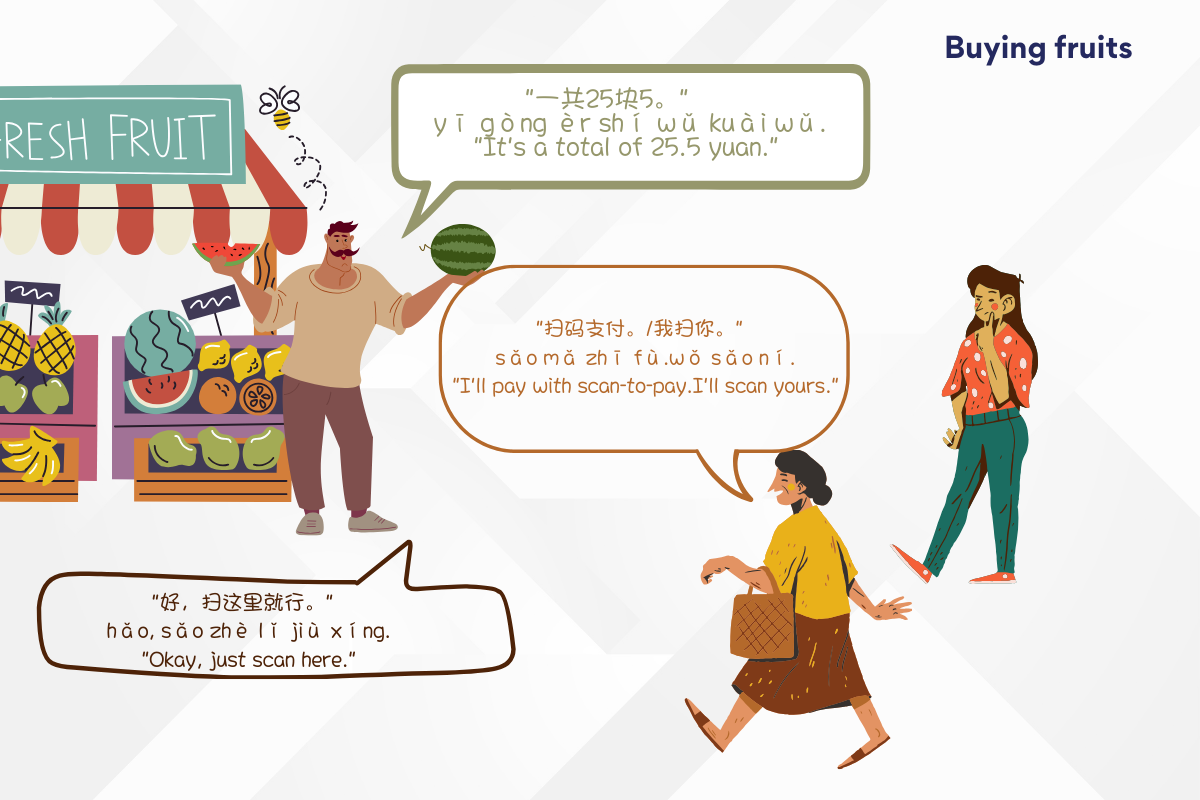
Scenario One: Buying fruits at a street-side store
Customer:"老板,这个西瓜怎么卖?"
lǎo bǎn, zhè ge xī guā zěn me mài?
"Boss, how much is this watermelon?"
Boss:"三块五一斤。"
sān kuài wǔ yī jīn.
"Three point five per pound."
Customer:"便宜点吧,三块吧。"
pián yi diǎn ba, sān kuài ba.
"Can you make it a bit cheaper, three yuan?" (Bargaining)
Boss:"行吧,您要哪个?"
xíng ba, nín yào nǎ ge?
"Sure, which one would you like?"
(After weighing...)
Boss:"一共25块5。"
yī gòng èr shí wǔ kuài wǔ.
"It's a total of 25.5 yuan."
Customer:"扫码支付。/我扫你。"
sǎo mǎ zhī fù.wǒ sǎo ní.
"I'll pay with scan-to-pay.I'll scan yours."
Boss:(Presenting the receiving code) "好,扫这里就行。"
hǎo, sǎo zhè lǐ jiù xíng.
"Okay, just scan here."
Customer:(After payment, showing the phone screen)"付过去了。"
fù guò qù le.
"I've transferred the money."
Boss: "好嘞,收到了!您慢走!"
hǎo lei, shōu dào le! nín màn zǒu!
"Alright, received! Take care!"
Scenario Two: Paying the bill after eating at a restaurant
Customer: "服务员,买单。"
fú wù yuán, mǎi dān.
"Waiter, check please."
Waiter: "您好,一共消费288元。请问是现金还是扫码?"
nín hǎo, yī gòng xiāo fèi èr bǎi bā shí bā yuán. qǐng wèn shì xiàn jīn hái shi sǎo mǎ?
"Hello, the total consumption is 288 yuan. Will you pay with cash or scan-to-pay?"
Customer: "刷卡可以吗?"
shuā kǎ kě yǐ ma?
"Can I swipe my card?"
Waiter: "可以的。"
kě yǐ de.
"Sure." (Bringing the POS machine)
Customer:(Swiping the card and entering the PIN)"好了。"
hǎo le.
"Done."
Waiter: "谢谢,这是您的小票。"
xiè xie, zhè shì nín de xiǎo piào.
"Thank you, here's your receipt."
Scenario Three: Going Dutch while dining with friends
A: "这顿一共350,我们五个人,一人70。"
zhè dùn yī gòng sān bǎi wǔ shí, wǒ men wǔ ge rén, yī rén qī shí.
"The total for this meal is 350, with five of us, 70 each."
B: "好,我微信转你。"
hǎo, wǒ wēi xìn zhuǎn nǐ.
"Sure, I'll transfer you through WeChat."
C: "我支付宝转你吧,账号是这个手机号吗?"
wǒ zhī fù bǎo zhuǎn nǐ ba, zhàng hào shì zhè ge shǒu jī hào ma?
"I'll use Alipay, is your account linked to this phone number?"
A: "对,都一样。"
duì, dōu yī yàng.
"Yes, it's the same."
By mastering these phrases, your daily transactions in China will go smoothly.