A Quick Guide to Negation in Chinese: Focusing on “不” (bù) and “没” (méi)
In learning Chinese, “不” (bù) and “没” (méi) are two of the most essential negation words. They may seem simple, but they have different uses. This article will clearly outline the common expressions with these two negation words to help you use Chinese more naturally.
Negation Expressions with “不” (bù)
“不” is often used to express subjective wishes, judgments, or the nature of things.
不认识 (bú rèn shi)
Explanation: Do not recognize; unfamiliar with someone.
Example:
- 我不认识他。
wǒ bú rèn shi tā.
I don't recognize him.
不好 (bù hǎo)
Explanation: Not good; indicates poor quality or undesirability.
Example:
- 这个东西不好。
zhè ge dōng xi bù hǎo.
This thing is not good.
不怕 (bú pà)
Explanation: Not afraid; shows lack of fear.
Example:
- 我不怕黑。
wǒ bú pà hēi.
I'm not afraid of the dark.
不舒服 (bù shū fu)
Explanation: Not comfortable; used to express a feeling of discomfort or unease.
Example:
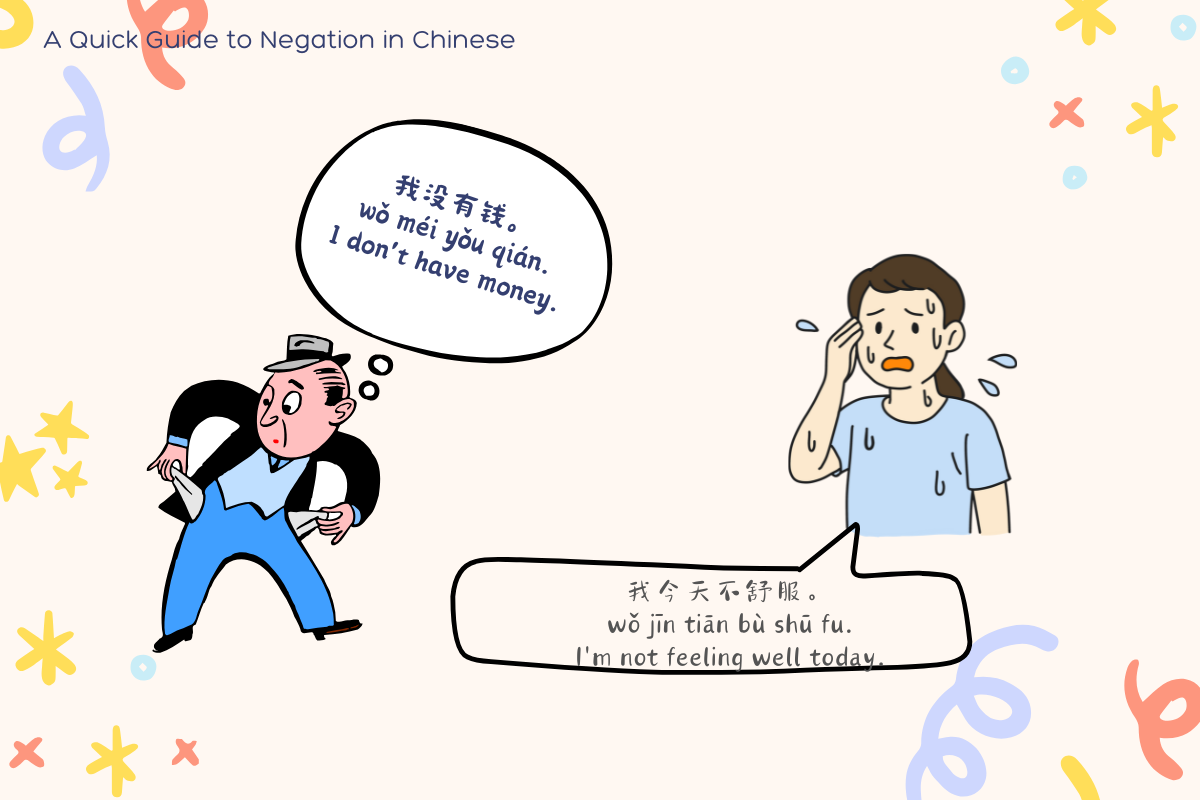
- 我今天不舒服。
wǒ jīn tiān bù shū fu.
I'm not feeling well today.
不一定 (bù yí dìng)
Explanation: Not necessarily; indicates uncertainty.
Example:
- 明天不一定下雨。
míng tiān bù yí dìng xià yǔ.
It may not rain tomorrow.
不够 (bú gòu)
Explanation: Not enough; signifies insufficiency.
Example:
- 钱不够。
qián bú gòu.
I don't have enough money.
不理 (bù lǐ)
Explanation: Ignore; to disregard or not pay attention.
Example:
- 他不理我。
tā bù lǐ wǒ.
He ignores me.
不想要 (bù xiǎng yào)
Explanation: Do not want; indicates a lack of desire for something.
Example:
- 我不想要这个礼物。
wǒ bù xiǎng yào zhè ge lǐ wù.
I don't want this gift.
Negation Expressions with “没” (méi)
“没” is commonly used to negate objective facts, indicating something “has not happened” or “does not exist.”
没有 (méi yǒu)
Explanation: To not have; not yet.
Example:
- 我没有钱。
wǒ méi yǒu qián.
I don't have money. - 他还没来.
tā hái méi lái.
He hasn't come yet.
没关系 (méi guān xi)
Explanation: It doesn't matter; never mind.
Example:
A: “对不起。”
duì bu qǐ.
"I'm sorry."
B: “没关系。”
méi guān xi.
"It's okay."
没问题 (méi wèn tí)
Explanation: No problem.
Example:
A: “你能帮我吗?”
nǐ néng bāng wǒ ma?
"Can you help me?"
B: “没问题!”
méi wèn tí!
"No problem!"
没错 (méi cuò)
Explanation: Correct; that's right.
Example:
A: “这是你的书吗?”
zhè shì nǐ de shū ma?
"Is this your book?"
B: “没错。”
méi cuò.
"That's right."
没用 (méi yòng)
Explanation: Useless; to be of no use.
Example:
- 这个方法没用。
zhè ge bàn fǎ méi yòng.
This method is useless.
没法 (méi fǎ)
Explanation: No way; there's no solution.
Example:
- 我没办法帮你。
wǒ méi bàn fǎ bāng nǐ.
I have no way to help you.
没意思 (méi yì si)
Explanation: Boring; lacking interest.
Example:
- 这部电影没意思。
zhè bù diàn yǐng méi yì si.
This movie is boring.
没想到 (méi xiǎng dào)
Explanation: Didn't expect; expresses surprise.
Example:
- 没想到会下雨。
méi xiǎng dào huì xià yǔ.
I didn't expect it to rain.
I hope this concise guide helps you better understand the common uses of “不” (bù) and “没” (méi) in Chinese. With more practice, your Chinese expressions will become more natural and accurate!