A Quick Guide to Negation in Chinese: Focusing on “不” (bù) and “没” (méi)

Thursday, November 6, 2025

In learning Chinese, “不” () and “没” (méi) are two of the most essential negation words. They may seem simple, but they have different uses. This article will clearly outline the common expressions with these two negation words to help you use Chinese more naturally.
Negation Expressions with “不” ()

“不” is often used to express subjective wishes, judgments, or the nature of things.

不认识 (bú rèn shi)

Explanation: Do not recognize; unfamiliar with someone.

Example:

  • 我不认识他。
    wǒ bú rèn shi tā.
    I don't recognize him.

不好 (bù hǎo)

Explanation: Not good; indicates poor quality or undesirability.

Example:

  • 这个东西不好。 
    zhè ge dōng xi bù hǎo.
    This thing is not good.

不怕 (bú pà)

Explanation: Not afraid; shows lack of fear.

Example:

  • 我不怕黑。
    wǒ bú pà hēi.
    I'm not afraid of the dark.

不舒服 (bù shū fu)

Explanation: Not comfortable; used to express a feeling of discomfort or unease.

Example:

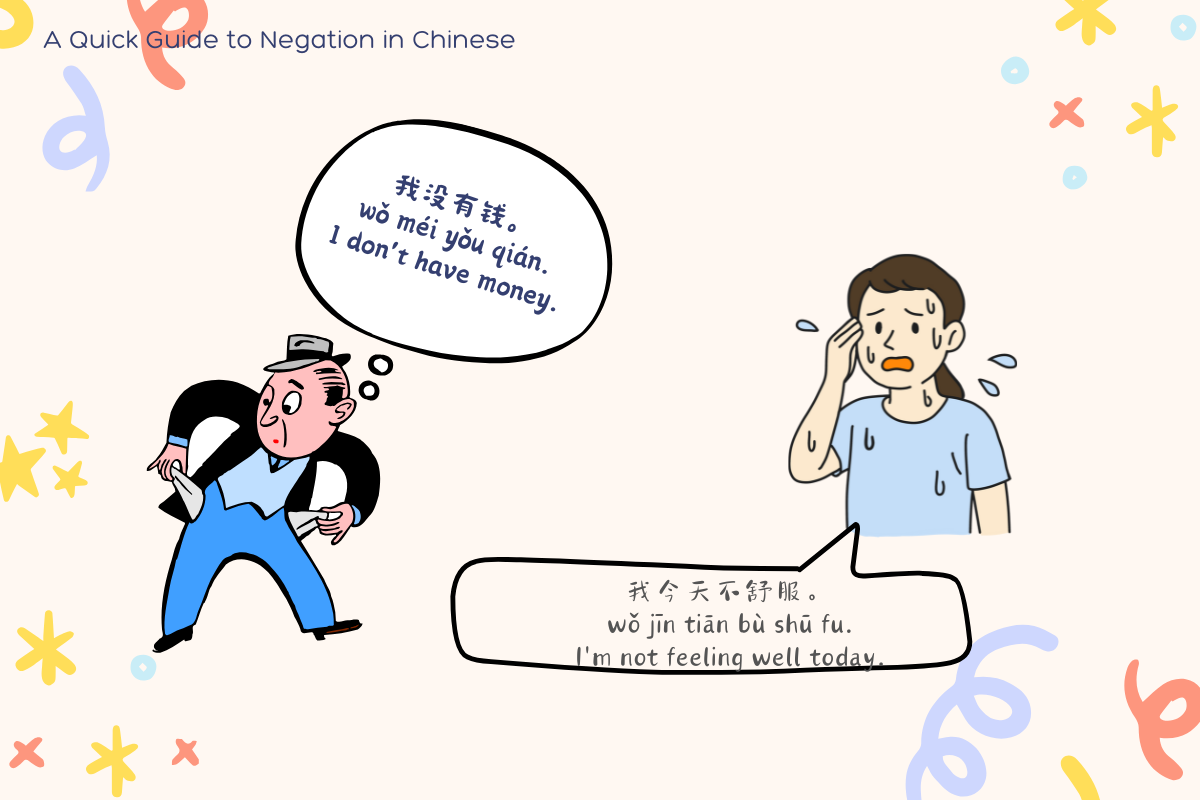
  • 我今天不舒服。
    wǒ jīn tiān bù shū fu.
    I'm not feeling well today.

不一定 (bù yí dìng)

Explanation: Not necessarily; indicates uncertainty.

Example:

  • 明天不一定下雨。 
    míng tiān bù yí dìng xià yǔ.
    It may not rain tomorrow.

不够 (bú gòu)

Explanation: Not enough; signifies insufficiency.

Example:

  • 钱不够。 
    qián bú gòu.
    I don't have enough money.

不理 (bù lǐ)

Explanation: Ignore; to disregard or not pay attention.

Example:

  • 他不理我。 
    tā bù lǐ wǒ.
    He ignores me.

不想要 (bù xiǎng yào)

Explanation: Do not want; indicates a lack of desire for something.

Example:

  • 我不想要这个礼物。
    wǒ bù xiǎng yào zhè ge lǐ wù.
    I don't want this gift.
Negation Expressions with “没” (méi)

“没” is commonly used to negate objective facts, indicating something “has not happened” or “does not exist.”

没有 (méi yǒu)

Explanation: To not have; not yet.

Example:

  • 我没有钱。
    wǒ méi yǒu qián.
    I don't have money.
  • 他还没来.
    tā hái méi lái.
    He hasn't come yet.

没关系 (méi guān xi)

Explanation: It doesn't matter; never mind.

Example:
A: “对不起。” 
        duì bu qǐ.
       "I'm sorry."
B: “没关系。” 
        méi guān xi.
      "It's okay."

没问题 (méi wèn tí)

Explanation: No problem.

Example:
A: “你能帮我吗?” 
      nǐ néng bāng wǒ ma?
       "Can you help me?"
B: “没问题!” 
      méi wèn tí!
     "No problem!"

没错 (méi cuò)

Explanation: Correct; that's right.

Example:
A: “这是你的书吗?”
        zhè shì nǐ de shū ma?
       "Is this your book?"

B: “没错。” 
        méi cuò.
      "That's right."

没用 (méi yòng)

Explanation: Useless; to be of no use.

Example:

  • 这个方法没用。
    zhè ge bàn fǎ méi yòng.
    This method is useless.

没法 (méi fǎ)

Explanation: No way; there's no solution.

Example:

  • 我没办法帮你。
    wǒ méi bàn fǎ bāng nǐ.
    I have no way to help you.

没意思 (méi yì si)

Explanation: Boring; lacking interest.

Example:

  • 这部电影没意思。 
    zhè bù diàn yǐng méi yì si.
    This movie is boring.

没想到 (méi xiǎng dào)

Explanation: Didn't expect; expresses surprise.

Example:

  • 没想到会下雨。
    méi xiǎng dào huì xià yǔ.
    I didn't expect it to rain.

I hope this concise guide helps you better understand the common uses of “不” (bù) and “没” (méi) in Chinese. With more practice, your Chinese expressions will become more natural and accurate!

Sign up for a free trial now!

FAQ / Tips

We offer a referral program that rewards both you and your friend with free classes.To participate, simply refer a friend to our program and once they successfully enroll, both you and your friend will receive free classes.We appreciate your support and look forward to helping you and your friend achieve your language learning goals.
Our Chinese learning method is focused on personalized and interactive one-on-one lessons with a professional teacher. The lessons are conducted live through our online teaching platform, which allows you to see and talk to the teacher. You can schedule the lessons at a time that suits you, and the teacher will tailor the lesson content to your specific needs and goals. During the lesson, you can ask questions and receive feedback from the teacher to ensure you understand and master the knowledge and skills being taught. We also have a student service team and academic coordinator team to assist you with your learning and provide any additional support you may need.Overall, our method is designed to be flexible, personalized, and interactive to help you achieve your language learning goals.
We offer a 30-day money-back guarantee for all new students.If you are not satisfied with our services within the first month, you may cancel your lessons and receive a refund for any unused lessons.We will only charge you for the first month of lessons, and refund the remaining balance to you promptly.Our goal is to ensure your satisfaction with our services, and we strive to provide the highest quality of instruction and support to all of our students.
Our students come from a wide range of ages, from 3 years old to over 80 years old. Our courses are tailored to each student's age and proficiency level to ensure they can receive maximum benefit and progress. Whether you want to learn Chinese as a second language or improve your existing Chinese skills, we can provide you with courses and resources that are suitable for you
Our learning is different from traditional language learning in a number of ways. Firstly, we use technology to enhance the learning experience and provide personalized learning paths for each student. Secondly, our focus is not just on language proficiency, but also on cultural understanding and practical application of the language.Thirdly, we place a strong emphasis on developing speaking and listening skills, as well as reading and writing.Additionally, we incorporate modern teaching methods and materials, such as multimedia resources and interactive exercises.Finally, our courses are designed to be flexible and adaptable, allowing students to learn at their own pace and according to their own schedule.
Before starting any Chinese language course, the teacher will assess your Chinese language proficiency level through a placement test.This helps to determine your current level of understanding and ability in Chinese, and allows the teacher to tailor the course materials and teaching methods to your specific needs and goals. The placement test may include assessments of your reading, writing, listening, and speaking skills.Based on the results of the test, the teacher will be able to recommend an appropriate course of study for you.