Welcome to 2026, the Chinese year of the Bingwu Horse. In Chinese culture, the horse is far more than an animal; it is a symbol of strength, speed, and loyalty. Today, I would like to take you on a journey through three thousand years of history by exploring a single Chinese character: “马(mǎ)”. You may discover that this character is itself a flowing picture.
From “Picture” to “Character”: The Transformation of a Horse
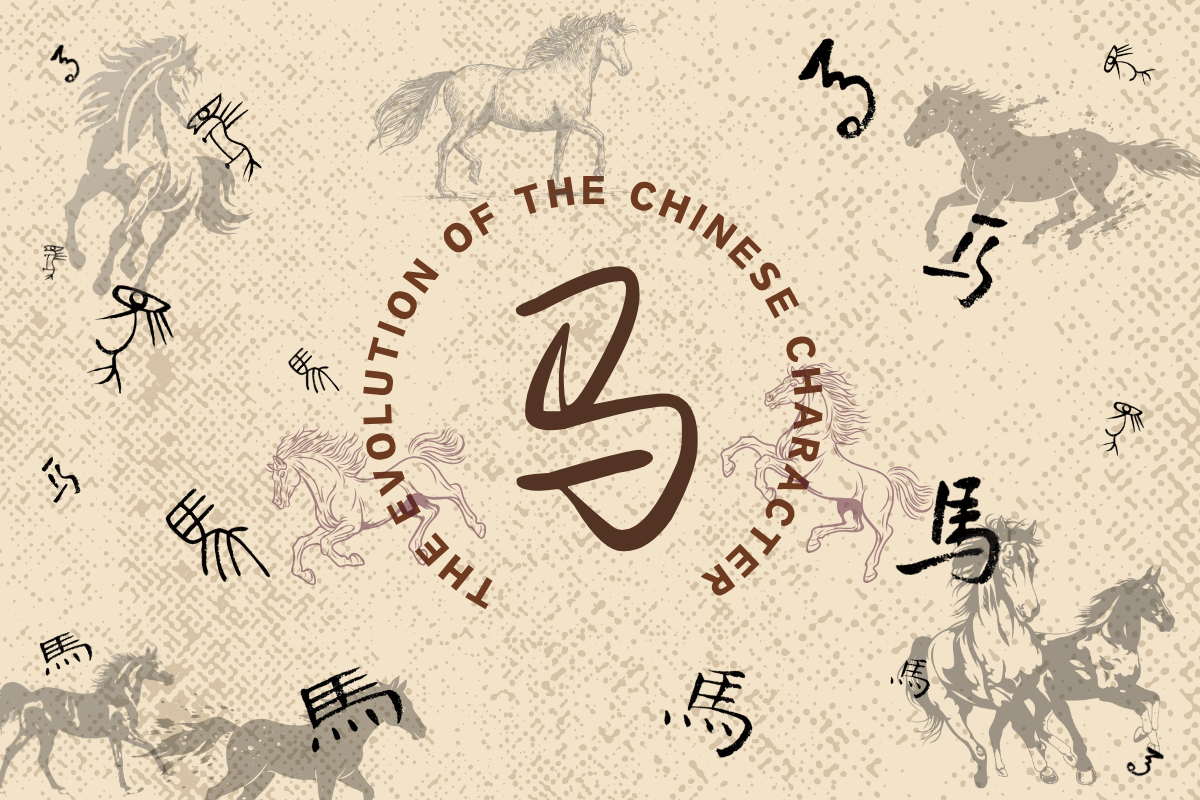
If you were to see the oracle bone script from the Shang Dynasty, dating back three thousand years, you might be astonished to find that the character “马(mǎ)” looked almost like a simple drawing.
The ancients were remarkably realistic. They depicted the side profile of a horse: large eyes, a flowing mane, four legs, and even a tail. This was not merely writing, but also the most direct observation of nature by early people. As time passed, in the bronze inscriptions of the Zhou Dynasty, the lines became heavier and more solemn, much like the bronze vessels on which they were cast.
After Qin Shi Huang unified China, he promoted the policy of“书同文(shū tóng wén)”—standardizing the written script—and small seal script came into being. At this stage, the character “马(mǎ)” was stretched into a longer form, with rounded and elegant lines. Although it still preserved the outline of a horse, it had already begun to take on a more regulated appearance.
The real “makeover” took place during the Han Dynasty. With the emergence of clerical script, the rounded lines were transformed into more angular strokes. The horse’s mane and tail became three horizontal lines, while its four legs turned into the four dots at the bottom. By the time of regular script, the character had fully settled into the form familiar to us today. Although the modern simplified“马(mǎ)”no longer resembles a literal horse, every stroke still holds the memory of history.
The Art of Calligraphy: The Spirit of the Dragon-Horse in Brush and Ink
Chinese calligraphy is not merely the act of writing; it is a dance upon paper. In the Year of the Horse, calligraphers are especially fond of using different script styles to express the spirit and vitality of the horse.
The “Speed and Passion” of Cursive Script
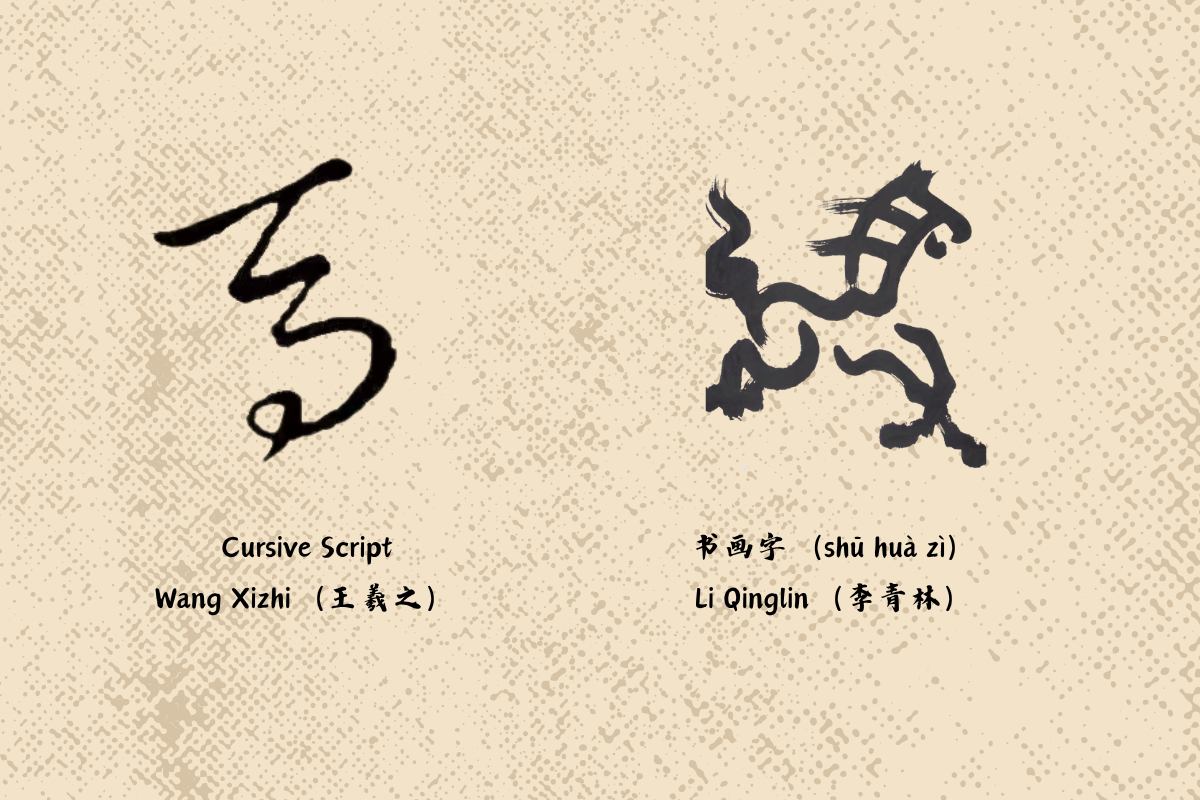
If you are drawn to speed (速度, sù dù) and passion, then you will surely love the cursive form of “马(mǎ)”. In wild cursive works, calligraphers often complete the character in a single sweeping motion, with rich and pale ink tones alternating like hoofprints upon snow; the flying white in the connected strokes resembles a mane streaming in the wind. This style no longer seeks neatness of form, but rather the pursuit of rhythmic vitality and spirit. Looking at such works, one almost seems to hear the thunder of countless galloping horses and to feel a kind of freedom that breaks all restraints.
速度(sù dù), noun, speed
Example:
- 这匹马的速度很快。
zhè pǐ mǎ de sùdù hěn kuài.
This horse is very fast. - 我喜欢汽车的速度。
wǒ xǐ huan qì chē de sù dù.
I like the speed of cars.
The Wonderful Fusion of Writing and Painting
China has a unique concept known as“书画同源(shū huà tóng yuán)”, meaning that calligraphy and painting share the same origin. In modern calligraphic art, there is an interesting experiment called“书画字(shū huà zì)”. Artists, such as Li Qinglin, deliberately emphasize the pictographic qualities of the character“马(mǎ)”, using calligraphic brushwork to depict the horse's head, mane, and tail. Such works are both character and painting, allowing even foreign friends who do not know Chinese to appreciate their charm at a glance.
Appreciating the Works of Contemporary Masters
To help you feel the atmosphere of the Year of the Horse more vividly, I have selected the creative inspirations of several contemporary artists. You may find works in similar styles at art exhibitions in China or online.
Du Jianmin’s “Freehand Horse”
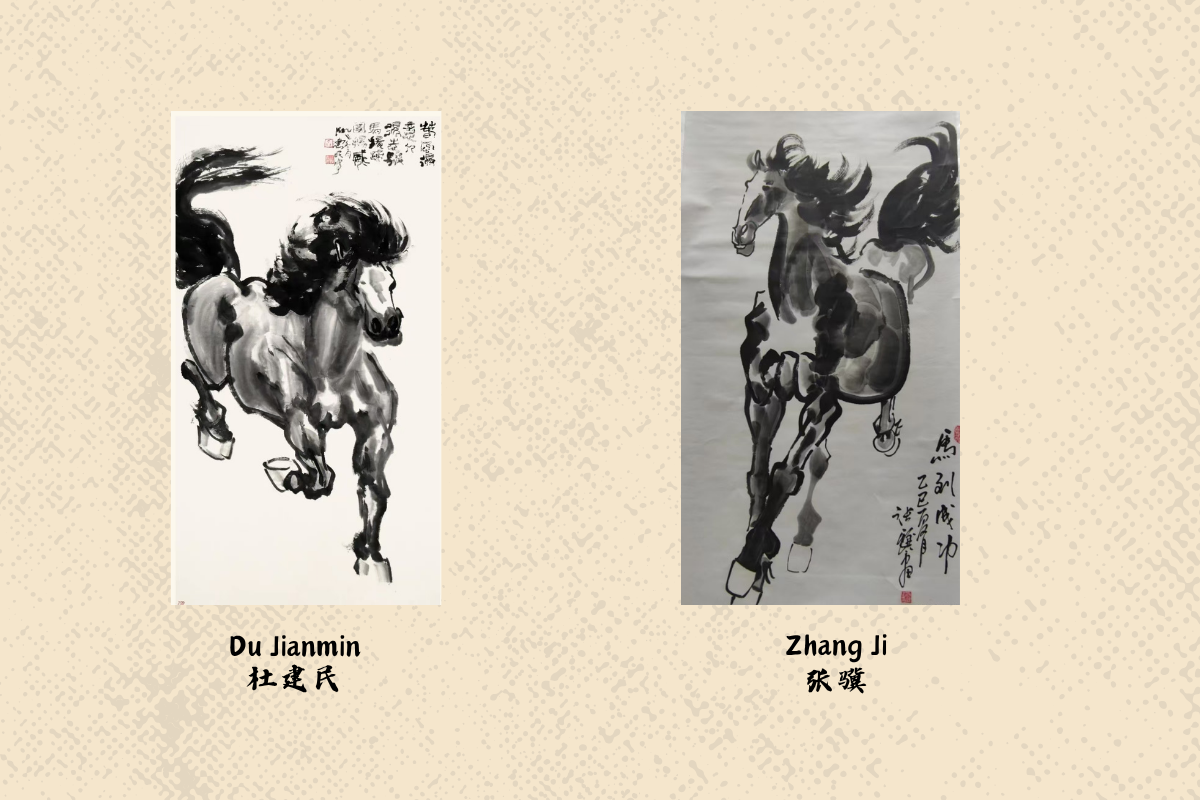
Mr. Du Jianmin excels at blending the lines of calligraphy into painting. The horses in his works possess both the structural strength of calligraphy and the lyrical beauty of ink painting. For example, in his work 《春风得意人得志》 (chūn fēng dé yì rén dé zhì, “Riding high in the spring breeze, a person fulfills his ambition”), the fine horse(骏马, jùn mǎ) raises its head and gallops forward, its mane flying. The use of dry and wet, dark and light ink is perfectly balanced, revealing a bold spirit of “万里可横行” (wàn lǐ kě héng xíng, “able to roam freely for ten thousand miles”).
骏马(jùn mǎ), noun,fine horse
Example:
- 草原上有一匹黑色的骏马。
cǎo yuán shàng yǒu yī pǐ hēisè de jùn mǎ.
There is a black steed on the grassland. - 他画了一匹奔跑的骏马。
tā huà le yī pǐ bēn pǎo de jùn mǎ.
He painted a galloping steed.
Zhang Ji's “Both Spirit and Form”
Painter Zhang Ji places greater emphasis on the posture of the horse. The horses in his paintings possess both vivid spirit and lifelike form, radiating upward energy and often symbolizing progress and auspiciousness.
From the vivid “wild horse” in oracle bone script to the soaring “divine horse” in works of calligraphy, the Chinese character “马(mǎ)” carries the Chinese people’s longing for a better life.
In the Year of the Horse, we often say “马到成功” (mǎ dào chéng gōng, “may you achieve success the moment you begin”). I hope this short essay helps you glimpse the profound breadth and depth of Chinese culture through a single character. The next time you see “马(mǎ)”, I hope you will also see that noble steed from three thousand years ago, galloping toward you through the fragrance of ink.